

From durable tactile sensors to contact-aware control and learning from demonstration, recent research is addressing one of industrial robotics’ most persistent challenges: enabling machines to perform precise assembly tasks when parts, positions and contact conditions are not entirely predictable.
Industrial robots have become exceptionally good at moving objects from one location to another. Modern vision systems can identify components, estimate their position and guide robotic arms with remarkable precision.
Inserting a connector, fitting a bearing onto a shaft, tightening a screw or positioning a component inside a narrow opening requires more than accurate movement. Once two surfaces come into contact, the relevant information changes. The robot must recognise resistance, detect misalignment, respond to friction and determine whether to continue, adjust its position or withdraw and try again.
Humans perform these corrections almost instinctively. When inserting a plug into a socket, vision guides the hand towards its destination, but touch helps complete the task. Our fingers detect resistance, adjust the angle and recognise when the connector has reached the correct position.
Research published in 2026 is addressing complementary challenges: making tactile sensors more robust and developing controllers that interpret contact events rather than simply recording another sensor signal.
Together, these developments point towards a more adaptable form of industrial automation, particularly for manufacturing environments where components and assembly conditions frequently change.
Making tactile sensors durable enough for industry
Vision-based tactile sensing has attracted considerable attention in robotics research. Instead of placing large numbers of individual force sensors inside a robotic fingertip, these systems use an internal camera to observe the deformation of a soft surface as it contacts an object.
Changes in the captured image provide information about contact geometry, pressure distribution, slipping and, depending on the system, the forces acting on the surface.
The approach can deliver detailed tactile information. However, laboratory performance is only one part of the engineering challenge.
In an industrial environment, tactile sensors must withstand abrasion, repeated concentrated loading, contamination and mechanical wear. A sensing surface that requires frequent replacement can introduce maintenance costs and reduce equipment availability, regardless of how accurately it measures contact.
A study published on 25 August 2026 by F. Richard Cottrell, Megha H. Tippur and Edward H. Adelson addresses this problem directly.
Their research, A Durable Vision-Based Tactile Fingertip for Robotic Manipulation, describes a sensor combining a soft silicone-gel layer with a thin, textured thermoplastic-polyurethane (TPU) protective film. The sensing region is also designed as a replaceable cartridge, allowing the contact surface to be serviced without replacing the entire sensor assembly.
The researchers evaluated the design through accelerated abrasion and repetitive-loading tests.
The evaluation included abrasion and repetitive-loading tests. In the abrasion comparison, the protective film reached its rupture endpoint after approximately two to three hours, compared with initial surface-film rupture after roughly 24–30 seconds for the commercial GelSight Mini and DIGIT specimens tested. A separate repetitive-loading protocol used a force of 39.2 N at 45 cycles per minute.
In the repetitive-loading experiments, nine examples of the new sensor remained functionally usable when testing ended after several days. The commercial specimens tested showed damage after tens of minutes.
The researchers report durability gains exceeding two orders of magnitude in their specified laboratory comparisons; the abrasion and repetitive-loading results should not be treated as interchangeable measures of service life.
These results should not be interpreted as a guarantee of equivalent service life on a production line. Industrial environments introduce additional variables, including oils, dust, varying contact geometry and changing loads.
Nevertheless, the research addresses an important practical issue: moving tactile sensing beyond sensitivity and resolution towards maintainability, predictable wear and replaceable components.
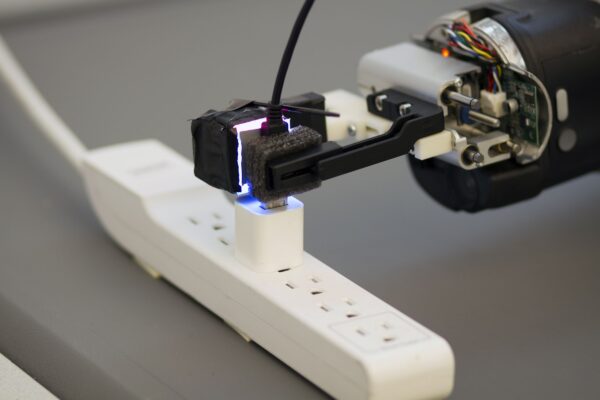
Figure 1: USB Connector Insertion A GelSight-equipped robotic gripper uses tactile feedback to locate and insert a USB connector, even when its initial grasp position is not perfectly aligned. Photo credit: Melanie Gonick / MIT.
Sensing contact is only the beginning
A durable tactile sensor solves only part of the problem. Once a robot detects contact, it must decide what that contact means and how to respond.
Traditional robotic control often represents a task as a sequence of positions and movements. The robot follows a predefined trajectory, moving its end effector through specified coordinates.
This works well when the environment is predictable. In contact-rich manipulation, however, the next stage of a task may depend on a physical event rather than simply reaching a particular position.
A component may need to touch a surface before sliding into place. A tool may have to release contact before moving to another stage. An insertion operation may require the robot to detect when resistance indicates a misalignment rather than successful engagement.
Research published in August 2026 by A. H. G. Overbeek, H. van der Kooij and M. Vlutters explores this distinction.
Their study, One-Shot Learning from Demonstration of Contact-Rich Robotic Manipulation by Identifying Physical Interactions, proposes a learning-from-demonstration method that explicitly represents the physical interactions occurring during a task.
Rather than learning only the demonstrated motion, the robot also identifies when contacts are established or broken and uses those events to determine transitions between task stages.
The approach combines learned trajectories with a hybrid position-force controller. During execution, the controller follows the demonstrated movement while responding to contact conditions that indicate when the next stage should begin.
The researchers evaluated the method in physical robot experiments involving doors and locks, bolt handling, screwing operations, object release and surface contouring.
They demonstrated that several contact-rich tasks could be reproduced after a single demonstration, without explicitly preprogramming the full task sequence. The approach also showed an ability to accommodate certain geometric variations.
In high-volume production, manufacturers can justify dedicated fixtures, precise component positioning and extensive programming. In high-mix, low-volume manufacturing, where products and configurations change frequently, the cost of repeatedly adapting equipment becomes more important.
A robot that learns not only where to move but also which physical interactions indicate successful progress could reduce some of that programming effort.
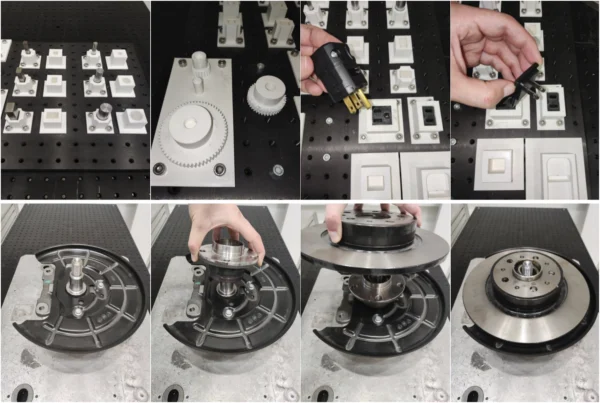
Figure 2: Adaptive Robotic Assembly Contact-rich assembly tasks used to evaluate adaptive robotic control, including peg-in-hole insertion, electrical connectors, gear assembly and automotive disc-brake components. The system detects misalignment and adjusts its control strategy in response to physical contact. Image credit: D. Rakovitis et al., DFKI Robotics Innovation Center / Frontiers in Robotics and AI, 2026 (CC BY).
From laboratory demonstrations to adaptive assembly
The connection to industrial manufacturing becomes particularly clear in research conducted by the German Research Center for Artificial Intelligence (DFKI) and the University of Bremen.
In a study published in Frontiers in Robotics and AI in March 2026, Dimitrios Rakovitis and colleagues investigated Fast Reprogramming and Adaptive Reproduction of Contact-Rich Assembly.
The objective was practical: teach a robot an assembly operation with limited demonstration effort, then allow it to handle variations in component position and geometry during execution.
The proposed framework combines motion and force information learned from human demonstrations with adaptive model predictive control and contact classification.
The controller uses an estimate of uncertainty to adjust its behaviour during contact. A contact classifier helps distinguish intended contact from misalignment, while exploration and retry mechanisms allow the robot to search for a suitable assembly position.
The system was trained using two demonstrations: one in which a human physically guided the robot through the task, and a second assisted execution that provided information about the intended contact conditions.
The researchers evaluated the approach on several assembly operations, including peg-in-hole insertion, two- and three-pin connectors, gear assembly and automotive disc-brake components.
Across 47 assembly trials, the adaptive system achieved an overall success rate of 83%, compared with 29.8% for a conventional Cartesian impedance controller.
These figures describe the tested tasks and conditions, rather than a general performance improvement applicable to every industrial assembly process.
Nevertheless, they illustrate the potential value of adapting control behaviour to the physical interaction.
One important finding concerned stiffness. Increasing controller stiffness did not necessarily improve assembly success. In some cases, excessive contact forces increased friction and caused components to become stuck.
By adapting both stiffness and the desired interaction force, the system could explore the contact surface more effectively while searching for the correct alignment.
Even screwdriving requires adaptability
A related engineering challenge appears in a task that may seem considerably simpler: tightening a screw.
Screwdriving is widely automated in mass-production environments, where components are positioned using dedicated fixtures and their geometry is highly predictable.
High-mix manufacturing presents different conditions. Components may vary between batches, fixtures may be less elaborate, and the exact position or orientation of a screw hole may be uncertain.
Research by Omey M. Manyar, Rutvik Patel and Satyandra K. Gupta, published in Robotics and Computer-Integrated Manufacturing in 2026, presents an autonomous robotic screwdriving system designed for such environments.
The system combines three-dimensional vision, force sensing, Cartesian impedance control and a screwdriving tool with passive compliance.
It also incorporates a physics-informed model of screw-tip motion and a failure-detection framework based on force measurements from the robot’s end effector.
The researchers evaluated the approach using M4, M5 and M6 screws across ten industrial components. The system was designed to accommodate hole-position uncertainty of up to 4 mm and angular uncertainty of 3 degrees.
Rather than assuming that every component is positioned exactly as expected, the approach uses sensing and control to identify deviations and respond during the operation.
The research demonstrates how adaptive control can address uncertainties that would otherwise require more precise fixtures or additional manual intervention.
This is particularly relevant to flexible production cells, where reducing changeover effort can be as important as optimising the speed of an individual operation.
Why position control is no longer enough
For decades, repeatability has been one of the defining strengths of industrial robotics.
A robot programmed to move to a particular position can return to that position with high consistency. In a stable production environment, this makes conventional position-based control highly effective.
But repeatability does not eliminate uncertainty in the surrounding process.
Components may vary within manufacturing tolerances. Fixtures can introduce small positioning errors. Parts may deform, friction conditions may change, and mating surfaces may not align exactly as expected.
Force and torque sensing, tactile feedback, compliance and impedance control therefore become increasingly important.
Vision can bring a robotic tool close to its destination. The final millimetre may require an entirely different form of feedback.
The industrial trade-off: flexibility versus cycle time
More sophisticated sensing and adaptive control do not come without costs.
For tactile sensors, manufacturers must evaluate long-term repeatability, resistance to dust and oils, cleaning requirements, calibration, replacement time and consumable costs.
For control systems, the trade-offs include computational complexity, validation effort and execution time.
A robot that explores a contact surface, changes stiffness or retries an insertion may achieve greater reliability while taking longer to complete the task.
The DFKI research illustrates this trade-off. Contact exploration and retry mechanisms improved assembly success, but some operations required more time.
On a production line manufacturing identical components at high volume, a simpler controller operating with precisely positioned parts may remain the better solution.
An additional few seconds spent locating the correct contact position may be acceptable if the alternative is a failed assembly, damaged component or operator intervention.
The relevant measure is therefore not simply the fastest possible cycle. It is the overall effectiveness of the manufacturing process, considering throughput, successful completion, maintenance requirements and the cost of failures.
This distinction is particularly important for European manufacturers exploring flexible production, smaller batch sizes and greater product customisation.
Towards robots that respond to the real world
None of these studies demonstrates a robot that can move freely among unrelated assembly stations and learn any new task without engineering support.
Significant challenges remain in sensor durability, contact modelling, controller validation, generalisation and integration into industrial production systems.
The durable tactile fingertip research addresses the physical reliability of contact sensing. Learning-from-demonstration methods show how physical interaction events can become part of a robot’s task representation. Adaptive assembly research demonstrates how force control, contact classification and recovery strategies can improve performance under geometric uncertainty. Autonomous screwdriving illustrates how similar principles can be applied to practical manufacturing operations.
These are separate research systems, at different stages of maturity, rather than components of a single proven platform. They nevertheless address the same limitation: physical contact rarely unfolds exactly as predicted.
Further progress will depend not only on precision, but on interpreting contact and adapting the next movement safely and repeatably.
For flexible manufacturing, that capability could prove more valuable than another incremental improvement in robotic repeatability.
Sources
- R. Cottrell, M. H. Tippur and E. H. Adelson, “A Durable Vision-Based Tactile Fingertip for Robotic Manipulation,” arXiv, August 2026.
- H. G. Overbeek, H. van der Kooij and M. Vlutters, “One-Shot Learning from Demonstration of Contact-Rich Robotic Manipulation by Identifying Physical Interactions,” arXiv, August 2026.
- Rakovitis et al., “Fast Reprogramming and Adaptive Reproduction of Contact-Rich Assembly,” Frontiers in Robotics and AI, March 2026.
- M. Manyar, R. Patel and S. K. Gupta, “Autonomous Robotic Screwdriving for High-Mix Manufacturing,” Robotics and Computer-Integrated Manufacturing, 98 (2026), 103172.
Image Captions and Credits
Main Image – Opening Image
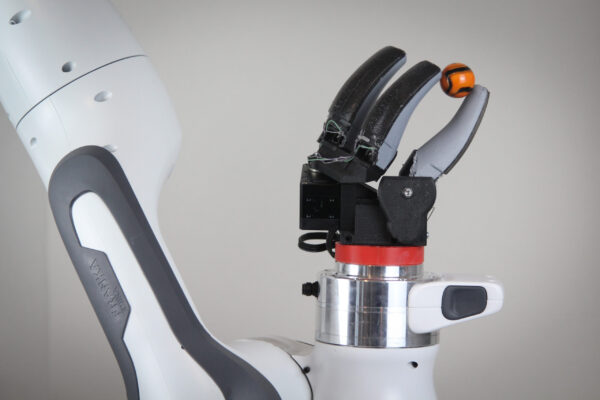
A robotic hand equipped with GelSight Svelte tactile sensors. The finger-shaped optical sensors provide high-resolution tactile feedback across a large contact area, enabling different types of robotic grasping.
Image credit: Courtesy of the researchers / MIT.


