

A long-term silicon agreement points towards a new generation of digital cockpits and driver-assistance systems. Behind it lies BMW’s Neue Klasse architecture: four central computers, zonal controllers and a software platform that must remain dependable and updatable throughout the vehicle’s life.
Selecting a chip for a car now has implications far beyond how quickly an infotainment screen responds. It helps determine how sensor data is processed, how vehicle systems communicate and which functions can be introduced by software in subsequent years. As automakers consolidate tasks previously distributed across dozens of electronic control units, computing architecture becomes a long-term platform decision rather than a component choice.
On 29 July 2026, BMW Group and Qualcomm announced an agreement naming Qualcomm as BMW’s lead compute silicon provider for next-generation digital cockpits and advanced driver-assistance and automated-driving (ADAS/AD) systems. The agreement covers Snapdragon Cockpit and Snapdragon Ride technologies, with the relevant model programmes beginning in the next decade. It extends an existing relationship: according to Qualcomm, the jointly developed Snapdragon Ride Pilot reached commercial launch with the BMW iX3 in November 2025. The new arrangement does not signal an immediate replacement of computers in today’s models.
Four central computers, four different jobs
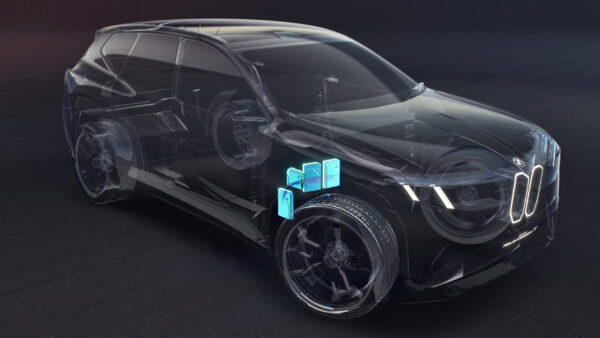
The broader architectural context comes from BMW’s Neue Klasse programme, which was presented independently of the future Qualcomm agreement. BMW groups key functions around four high-performance computers, or “superbrains”, responsible for driving dynamics, automated driving, infotainment, and basic vehicle and comfort functions. BMW says the four together offer more than twenty times the computing capacity of the vehicle generation used for its comparison. That claim concerns BMW’s overall architecture; it is not a performance specification for the as-yet-unnamed chips in the new Qualcomm supply programme.
The four domains have different requirements. Infotainment must handle graphics, navigation, voice interaction and increasingly sophisticated interfaces. Driver-assistance systems interpret environmental data. Chassis and propulsion control need to coordinate actions tied directly to vehicle movement. Centralisation does not make those requirements interchangeable. The engineering question is where functions should be consolidated, and where their different timing and safety demands require separation.
BMW’s Heart of Joy illustrates the value of bringing related functions together. It coordinates propulsion and driving dynamics, including the interaction between acceleration, braking and energy recuperation. When an electric vehicle slows, its control system must decide how to distribute braking between the electric drive and friction brakes. Joint optimisation can reduce the need for decisions to pass between multiple independent controllers.
The Qualcomm agreement, however, specifically concerns digital cockpit and ADAS/AD computing. It should not be read as an announcement that Qualcomm will supply all four Neue Klasse superbrains, or that every vehicle function is being placed on a single chip.
Heterogeneous computing rather than one processor for everything
Qualcomm’s Snapdragon Digital Chassis portfolio spans several automotive computing roles. Its announcements reference Snapdragon Cockpit and Ride, Elite-class automotive platforms and dedicated AI accelerators. These are products designed for different domains but developed within a broader architectural family.
For hardware engineers, the interesting issue is how tasks are divided within such a platform. Automotive workloads range from general application software to image rendering, signal processing and neural-network inference. Executing all of them on one type of processor is unlikely to be efficient. Qualcomm describes its Snapdragon Cockpit Elite and Snapdragon Ride Elite platforms in terms of an Oryon CPU, graphics processing and Hexagon neural processing. The combination illustrates heterogeneous computing: different engines handle the workloads for which they are best suited.
A CPU manages general software and system operations; a GPU handles graphics and parallel computation; and an NPU is intended to accelerate the operations common in machine-learning models. Yet the arithmetic throughput of an accelerator is only part of the picture. Moving data between engines, accessing shared memory and waiting for resources all add latency. Engineers therefore need to measure end-to-end execution time, not just peak operations per second.
These are published characteristics of Qualcomm platform families, not a disclosed bill of materials for future BMW vehicles. The July agreement does not identify which chips or accelerators will appear in individual models. Equally, the reference to ADAS/AD does not establish any particular level of driving automation or imply unsupervised operation.
Zonal controllers shorten the physical connections
Central computing also changes the wiring problem. Sensors, lights, actuators and smaller electrical functions are distributed around a vehicle. Connecting each device directly to a distant central computer could erase part of the benefit of consolidating processing. In a zonal architecture, physically adjacent devices connect instead to a local controller, which exchanges data with one or more central computers. Depending on its design, the zonal controller may also bridge communication interfaces and manage power distribution.
BMW divides Neue Klasse wiring into four physical zones: front, centre, rear and roof. According to the automaker, its revised harness uses about 600 metres less cable and is approximately 30% lighter than the previous architecture used in its comparison. These are figures for BMW’s particular implementation, not universal savings available from any zonal design. NXP has also described the general engineering principle behind local zonal aggregation.
The four wiring zones and four superbrains should not be confused. Zones are defined by location, while central computers are organised by function. A controller in the rear of a vehicle might pass information to several central computers; a single central computer might receive information from multiple physical zones. Local cabling becomes shorter, but the interconnects to the central computers must carry aggregated traffic and meet strict delivery requirements.
Sharing compute resources demands isolation and scheduling
Higher network bandwidth does not guarantee that every message arrives on time. A control command, a camera stream and a software download cannot necessarily be treated equally. Shared networks need priorities and resource management so that bulk traffic does not obstruct time-sensitive information. Similar contention can occur inside a computer when several applications share CPU cores, memory buses and accelerators. Low average utilisation is little reassurance if multiple tasks reach peak load simultaneously.
System architects must define which software components can share resources, and where isolation is necessary. Memory protection is one part of this; controlling interference between neighbouring tasks is another. The issue becomes especially important when workloads with different functional-safety requirements run on shared hardware. Qualcomm advertises virtualisation and support for multiple software environments in its Elite-class automotive offerings, but the carmaker still has to validate behaviour in the specific production configuration.
That validation spans the complete path from a sensor event to an actuator command, including queueing and communication between processors. Engineers must also examine fault responses: what continues running, what is shut down and how abnormal behaviour is detected. Power delivery and cooling have to sustain the required performance under prolonged operating conditions, rather than only during a short benchmark run.
Software must outlast the initial hardware generation
A supply agreement for vehicles entering future model programmes is also a commitment to years of software maintenance after delivery. A common computing platform can make it easier to reuse software across models and reduce the work of adapting each function to a different collection of control units. But variants in sensors, equipment and performance requirements still demand engineering work and testing.
Even an over-the-air update changes the workload of the vehicle. A new version may consume more memory, increase network traffic or add demand to an AI accelerator. Before deployment, teams must verify that existing functions still meet their timing and resource budgets and that a failed or interrupted update can be recovered safely.
As more applications share each computing platform, validating each in isolation becomes less informative. An application may work correctly in a laboratory test and behave differently in the complete vehicle when competing software is active. System integration, tracing and diagnostic tools therefore become as important to the lifecycle of the vehicle as the initial choice of processor.
BMW’s wider Neue Klasse strategy and its renewed Qualcomm collaboration reflect the same architectural shift: away from a vehicle defined by individual control units, towards one in which shared computing, zonal connectivity and maintainable software are central elements of the engineering design.
IMAGE CAPTION: Illustration of BMW’s Neue Klasse computing architecture, with four central “superbrains” supporting major vehicle functions. Image credit: BMW Group. (Use subject to image rights clearance.)
SOURCES | PRINT: Qualcomm Technologies, BMW Group compute silicon agreement, 29 July 2026.
BMW Group, “Four Superbrains for the Neue Klasse”, 11 March 2025.
NXP Semiconductors, technical background on zonal automotive architectures.


