

Following functional validation of a 22 nm FD-SOI prototype, Fraunhofer is offering a RISC-V and OpenTitan-based Secure Element as licensable IP. The approach could help SoC, ASIC and chiplet designers build secure boot, key management and post-quantum capabilities into their architectures—but security evaluation and product integration remain essential.
From a standalone security chip to embedded silicon IP
In September 2026, Germany’s Fraunhofer research organisation announced that its RISC-V Secure Element prototype had successfully completed functional validation in silicon. The design is now being offered as intellectual property (IP) for integration into systems-on-chip (SoCs), application-specific integrated circuits (ASICs) and chiplet-based architectures.
The distinction matters. Rather than adding a separate security device to a board, semiconductor designers could incorporate the security subsystem directly into their own silicon. Based on RISC-V and the OpenTitan project, the implementation is intended to provide a hardware root of trust (HRoT) for authenticating firmware, managing cryptographic keys and establishing device identity.
The work was carried out within the Trusted Electronics Bayern (TrEB) centre by three Fraunhofer institutes. Fraunhofer IIS led chip design and implementation; AISEC contributed hardware security and post-quantum cryptography expertise; and EMFT focused on physical inspection and analysis of the silicon.
The prototype was fabricated using GlobalFoundries’ 22 nm FD-SOI technology in Dresden, Germany. Moving beyond simulation and emulation to a tested physical device is a significant development milestone. It does not, however, mean that the design has completed all security evaluations required for deployment in a commercial product.
Why security has to start in hardware
When a networked industrial controller powers up, its processor loads firmware before enabling sensors, communication interfaces and control functions. But first, the system has to establish whether that firmware is intact and whether it is a version authorised by the manufacturer.
The problem becomes more acute for IoT equipment expected to operate for years and receive remote updates. If the only security mechanisms reside in the software they are supposed to protect, a successful compromise of that software may also undermine the mechanisms used to verify it.
An HRoT provides a trusted starting point that is not wholly dependent on the application processor or operating system. Typically implemented as an isolated hardware component or subsystem, it can handle sensitive operations such as code authentication, key management and cryptography.
One principal use is secure boot. A hardware-anchored initial boot stage and trusted information authenticate the next stage in the startup chain, usually through digital-signature verification. Each stage then checks the code it is about to execute. If verification fails, the system can refuse to launch the code or enter a defined recovery mode.
Secure boot is not proof that authorised firmware is free from vulnerabilities, nor does it replace runtime protection. Its role is narrower but fundamental: allowing a system to start from approved code under a defined security policy.
Protecting cryptographic keys is another central function. Instead of placing private keys in memory accessible to the main processor, a Secure Element can perform cryptographic operations internally without exposing the underlying key to application software. This separation is particularly relevant to devices deployed at remote sites where attackers may obtain physical access. Its effectiveness still depends on isolation, physical implementation and resistance to hardware attacks.
RISC-V and OpenTitan: distinct roles in an open architecture
Fraunhofer’s choice of RISC-V and OpenTitan reflects an approach rooted in open architectures, but the two technologies are not interchangeable.
RISC-V is an open instruction set architecture (ISA): it defines the interface between software and a processor implementation. Designers can develop processors tailored to particular workloads, including compact cores embedded in security subsystems. Using RISC-V does not itself make a chip secure, but it provides architectural flexibility for integrating dedicated functions.
OpenTitan, by contrast, is an open-source initiative to develop a silicon root of trust. Its architecture encompasses a dedicated processing environment, cryptographic functions, key-management mechanisms and infrastructure for secure boot and isolation of sensitive operations.
Together, they allow the processing core to operate as part of a broader hardware security architecture rather than as an isolated CPU. An open foundation can also make design review, security analysis and application-specific adaptation more accessible.
There is an important licensing distinction: OpenTitan is an open-source project, whereas Fraunhofer is offering its particular implementation as licensable IP. The use of OpenTitan does not establish that every detail of the Fraunhofer design is publicly available. Openness is not a security guarantee either. Any hardware modifications, interfaces or integration choices must be assessed for their effect on the threat model. For chip developers, the practical opportunity is to adapt an established architectural foundation rather than begin every security subsystem from scratch.
Post-quantum cryptography for long-lived systems
Post-quantum cryptography (PQC) is another element of Fraunhofer’s proposed platform. It is particularly relevant to industrial equipment designed for long service lives. Widely used asymmetric cryptographic schemes such as RSA and elliptic-curve cryptography could become vulnerable to sufficiently capable future quantum computers. A device installed today may still need to authenticate signatures or establish secure communications a decade from now.
Migration to PQC, however, creates engineering constraints for embedded developers. Some algorithms require larger keys or signatures, additional memory and more computation. On microcontrollers with limited power and memory budgets, these requirements can affect boot times, energy consumption and silicon area.
Fraunhofer says the platform supports both conventional and post-quantum cryptography. AISEC is working on hardware implementations and acceleration of cryptographic operations to make stronger algorithms practical in resource-constrained systems.
The information published with the announcement does not provide a complete benchmark table specifying every implemented algorithm, execution time and power draw. It would therefore be premature to attribute particular performance results for schemes such as ML-KEM or ML-DSA to the prototype. Integrating PQC into a Secure Element may offload the application processor and isolate sensitive operations, but its engineering value will depend on measured performance, security evaluation and the ability to update implementations during a product’s lifetime.
Integration into SoCs, ASICs and chiplets
Many commercial Secure Elements are standalone chips connected to a host processor. This arrangement creates a relatively clear physical boundary between security and application functions, and in some cases allows designers to select an already evaluated component. The trade-offs include PCB area, additional interfaces and another component in the supply chain.
Fraunhofer’s IP approach offers an alternative: integrating security functions into the chip architecture itself. An SoC or ASIC manufacturer could tailor internal interfaces and security policy to the needs of its system. For compact or high-volume products, this can be attractive, but it transfers substantial responsibility for integration and validation to the adopting manufacturer.
Trust boundaries must be designed with particular care when a security subsystem shares silicon with CPU cores, memory controllers, accelerators and communication interfaces. The architecture needs to prevent other blocks from reading protected information or bypassing isolation. Access controls, memory partitioning, debug-port protections and DMA restrictions all become part of the security case. Shared resources such as clocks and power rails may also influence exposure to physical attacks.
Chiplet architectures add another layer of complexity. If separate silicon dies share a package, designers must determine how each component is authenticated and how communication between them is protected. Fraunhofer identifies chiplet integration as a potential use case, but its September announcement did not present a fully demonstrated multi-chiplet system incorporating the security block. At this stage it is an integration option offered to developers.
What has the prototype actually demonstrated?
Functional validation means the design has been exercised in physical silicon, beyond earlier simulation or emulation, and that the operations included in the validation process behaved as intended. It does not demonstrate resistance to attack.
A security component can perform all its specified functions and still leak secrets through variations in power consumption, execution timing or electromagnetic emissions. Fraunhofer AISEC plans further work on physical attack resistance, including side-channel analysis and fault injection. These techniques examine whether observations of circuit behaviour can reveal protected data or whether deliberately induced errors can defeat security controls.
The source material cites Common Criteria EAL7 and EAL6 qualifications associated with the AISEC and EMFT evaluation facilities. These references must not be confused with certification of the new Secure Element: no such product-level certification was announced. EMFT is also involved in structural silicon analysis using microscopy-based methods to inspect aspects of the physical implementation.
The result is a design that has advanced far enough to be proposed for industrial integration, while further testing and security assessment remain necessary before its suitability for high-assurance applications can be established.
The industrial challenge: security across the product lifecycle
A Secure Element is one part of securing long-lived industrial IoT equipment. Devices in factories, energy networks and control installations may stay in service for years, often with limited opportunities for downtime or maintenance.
One sensitive stage is provisioning: assigning device identities, keys and initial security information under controlled conditions, from manufacturing to deployment. A private key exposed on the production line can compromise a product even if the hardware security architecture is otherwise sound.
Firmware updates create a second challenge. Systems must verify update origin and integrity, prevent rollback to vulnerable versions and provide a recovery path if installation fails. Industrial availability also matters. A failed integrity check cannot always result in an uncontrolled shutdown of a production process; safe recovery and maintenance modes must be designed without creating backdoors around security policy.
These design decisions are increasingly relevant to European manufacturers under the EU Cyber Resilience Act (CRA). Reporting obligations for actively exploited vulnerabilities and severe security incidents have applied since 11 September 2026, while the regulation’s main product cybersecurity obligations are scheduled to apply from 11 December 2027. The CRA places greater emphasis on security throughout the lifecycle of products with digital elements. An HRoT can support some technical measures, but implementing one is not, by itself, evidence of legal compliance.
For embedded-system manufacturers, decisions about device identity, protected key storage, firmware authentication and secure updates therefore belong in the earliest stages of architecture design, rather than as late additions to an otherwise completed product.
From an open foundation to industrial IP
By licensing the Secure Element as IP, Fraunhofer is offering semiconductor manufacturers another route to an integrated root of trust built on an open architectural foundation. The approach may reduce reliance on an external security chip and give designers closer control of their system architecture. In return, developers must take responsibility for interface integration, validation and the security implications of any changes.
This remains a silicon-validated design offered for integration, not a publicly certified, deployment-ready security product. Its significance lies in moving the hardware root of trust earlier in the design process: security becomes part of the chip architecture, influencing boot, key handling, firmware maintenance and protection over the product’s operating life.
Image caption:
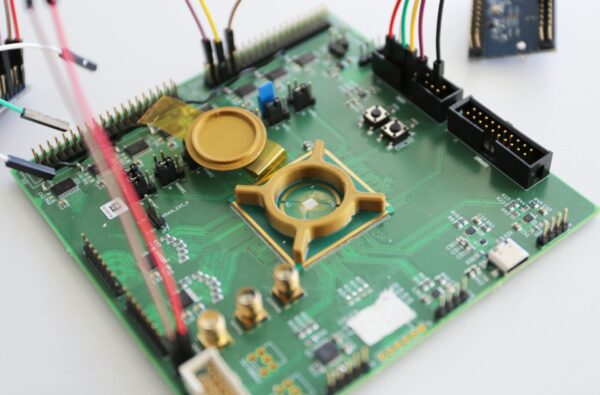
Fraunhofer’s RISC-V Secure Element silicon prototype on a dedicated evaluation board. The OpenTitan-based implementation is intended for integration into SoCs, ASICs and chiplet architectures. Photo: © Fraunhofer AISEC.
Sources:
Fraunhofer IIS, “Fraunhofer RISC-V Secure Element Accelerates Secure Chip Development After Successful Silicon Validation,” September 2026. https://www.iis.fraunhofer.de/en/pr/2026/press-release-risc-v-secure-element-licensable.html
Fraunhofer AISEC and Fraunhofer EMFT, technical and evaluation background cited by Fraunhofer IIS; OpenTitan project documentation.
European Commission, Cyber Resilience Act: reporting obligations and implementation timeline. https://digital-strategy.ec.europa.eu/en/policies/cyber-resilience-act


