




The Norwegian company’s SBM140B combines a claimed 84 dBA signal-to-noise ratio with a 146 dB SPL overload point and 24-bit digital output, with production planned for early 2027.
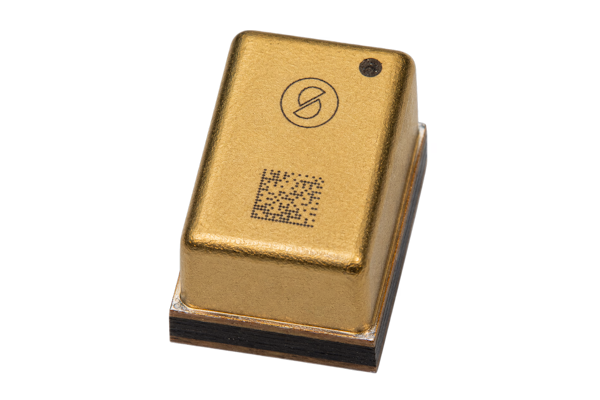
Norwegian sensor company sensiBel has introduced the SBM140B, an optical MEMS microphone specified for an 84 dBA signal-to-noise ratio, a 146 dB SPL acoustic overload point and a 136 dB dynamic range.
The device has already been sampled to selected customers, according to the company, while production is scheduled for the first quarter of 2027. Its specifications therefore describe a pre-production product rather than a component currently available in volume.
Instead of using the capacitive readout structure found in conventional MEMS microphones, sensiBel’s architecture measures movement of the microphone diaphragm optically. The company describes an optical module comprising a VCSEL, a photodetector and a diffractive optical element that produces a measurable pattern as the diaphragm moves.
Separating diaphragm motion from a conventional capacitive backplate is intended to address a persistent microphone-design trade-off: detecting weak signals above the sensor’s own noise floor while retaining sufficient headroom for very high sound-pressure levels.
For the SBM140B, sensiBel specifies an equivalent input noise of 10 dBA SPL over 20 Hz to 20 kHz. Its 146 dB SPL acoustic overload point is measured at 1 kHz and 10% total harmonic distortion. The company says the microphone can therefore capture quiet or distant sounds and high-level acoustic events using one configuration, without clipping or compression.
Those characteristics are potentially useful beyond conventional audio recording. Low self-noise can improve the usable signal supplied to beamforming and acoustic-processing algorithms, particularly when arrays are detecting distant or low-amplitude sources. High overload tolerance is relevant to industrial monitoring, instrumentation and acoustic detection around machinery, where the same sensor may encounter both weak diagnostic signals and intense background sound.
The possible applications identified by sensiBel include acoustic cameras, microphone arrays, robotic systems, drone detection, measurement equipment and immersive audio. These remain target markets rather than announced design wins for the SBM140B.
The microphone provides 24-bit digital output and supports PDM, I²S and eight-channel TDM interfaces. Its maximum sampling rate is specified at 192 kHz, with clock frequencies from 1.5 MHz to 12 MHz. The bottom-port device operates from a 1.8 V supply and is housed in a 6 × 3.8 × 4 mm package, with flex and surface-mount configurations listed by the company.
For comparison, sensiBel’s existing SBM100B is specified for an 80 dBA SNR, the same 146 dB SPL overload point and a 132 dB dynamic range. That device is already shipping, while the new SBM140B raises the specified SNR by 4 dB and adds the corresponding increase in dynamic range.
The performance figures and sensiBel’s claims of market-leading noise and overload characteristics have not been independently benchmarked in the material published with the launch. Engineers considering the part will also need detailed information on frequency response, power consumption, channel matching, temperature behaviour and production tolerances. A public, complete datasheet was not available with the announcement.
Even with those open questions, the SBM140B is a substantive European sensor development. Its importance lies not simply in a higher headline specification, but in the use of a different physical readout mechanism to extend both ends of the microphone’s usable acoustic range.
Sources:
- sensiBel SBM140B announcement, 31 August 2026
- SBM140B product specifications
- sensiBel optical MEMS technology overview
Image Credit: https://www.sensibel.com/