




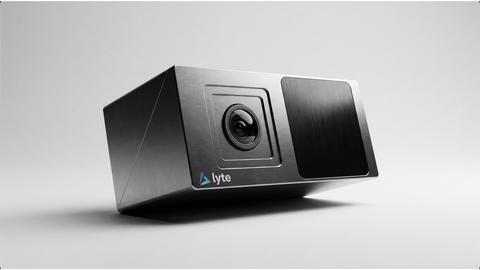
The Series C values Lyte at $1.6 billion as the company moves its multimodal LyteVision platform into production deployments across inspection, logistics and manufacturing.
Lyte has raised $165 million in a Series C round led by Maverick Silicon to expand production of its custom sensing silicon and LyteVision perception platform for robots and autonomous systems. The financing values the California-based company at $1.6 billion post-money and brings its total funding since 2021 to $272 million.
The scale of the round is notable, but the underlying technology is the more significant part of the announcement. Lyte is developing the robot’s perception stack as an integrated system spanning custom silicon, multimodal sensors and spatial software, rather than assembling sensing functions from independent off-the-shelf components.
According to the company, its LyteVision platform combines 4D coherent vision, high-resolution imaging and inertial sensing on a single synchronized timeline. Lyte says the system measures position and motion directly instead of reconstructing them entirely in software, with the aim of providing robots with real-time spatial data they can use when navigating and acting in dynamic environments.
This approach targets a fundamental issue in Physical AI: an AI model can only make reliable decisions if the sensor data describing the physical environment is sufficiently accurate, timely and consistent. Latency between sensors, calibration drift and differences in how individual sensing components represent motion can all complicate a robot’s interpretation of its surroundings.
“Physical AI has a sensing problem before it has a model problem,” said Alexander Shpunt, CEO and co-founder of Lyte. The company’s strategy is to control the perception chain from the underlying silicon to the spatial data delivered to the robotic system.
Lyte emerged from stealth in January 2026. The company now says it has entered production and is shipping to robotics customers in the inspection, logistics and manufacturing sectors. It has not disclosed the customers, shipment volumes or performance benchmarks for the platform, so these initial deployments should not yet be interpreted as evidence of established high-volume production.
The new capital will be used to scale production of Lyte’s sensing silicon and the LyteVision platform, develop its AI and perception capabilities, and expand deployments with robotics and industrial customers. The company also plans to increase hiring across silicon design, software, optics, manufacturing, operations and commercial functions.
Lyte was founded in 2021 by Alexander Shpunt, Arman Hajati and Yuval Gerson, former Apple and PrimeSense engineers who worked on depth-sensing and perception technologies. PrimeSense developed the 3D sensing technology used in Microsoft’s original Kinect system before being acquired by Apple in 2013.
That background informs Lyte’s current strategy of combining dedicated sensing hardware and software in a vertically integrated platform for robotics.
Avigdor Willenz, chairman of Lyte, said the company’s ownership of the silicon allows it to control multiple layers of the way a robot perceives its environment. That vertical integration could give Lyte greater control over synchronization, calibration and data processing, although its advantages will ultimately need to be demonstrated across commercial deployments.
Andrew Homan, managing partner at Maverick Silicon, has joined Lyte’s board following the investment. Fidelity Management & Research Company, which led the company’s Series B, also participated in the round, alongside Atreides Management, Key1 Capital, Ora Global—formerly Exor Ventures—and other existing and new investors.
LyteVision was named a CES 2026 Best of Innovation product in the robotics category. The company is headquartered in Sunnyvale, California.
Source: Lyte announcement distributed through Business Wire, 2 September 2026
Image credit: Lyte