



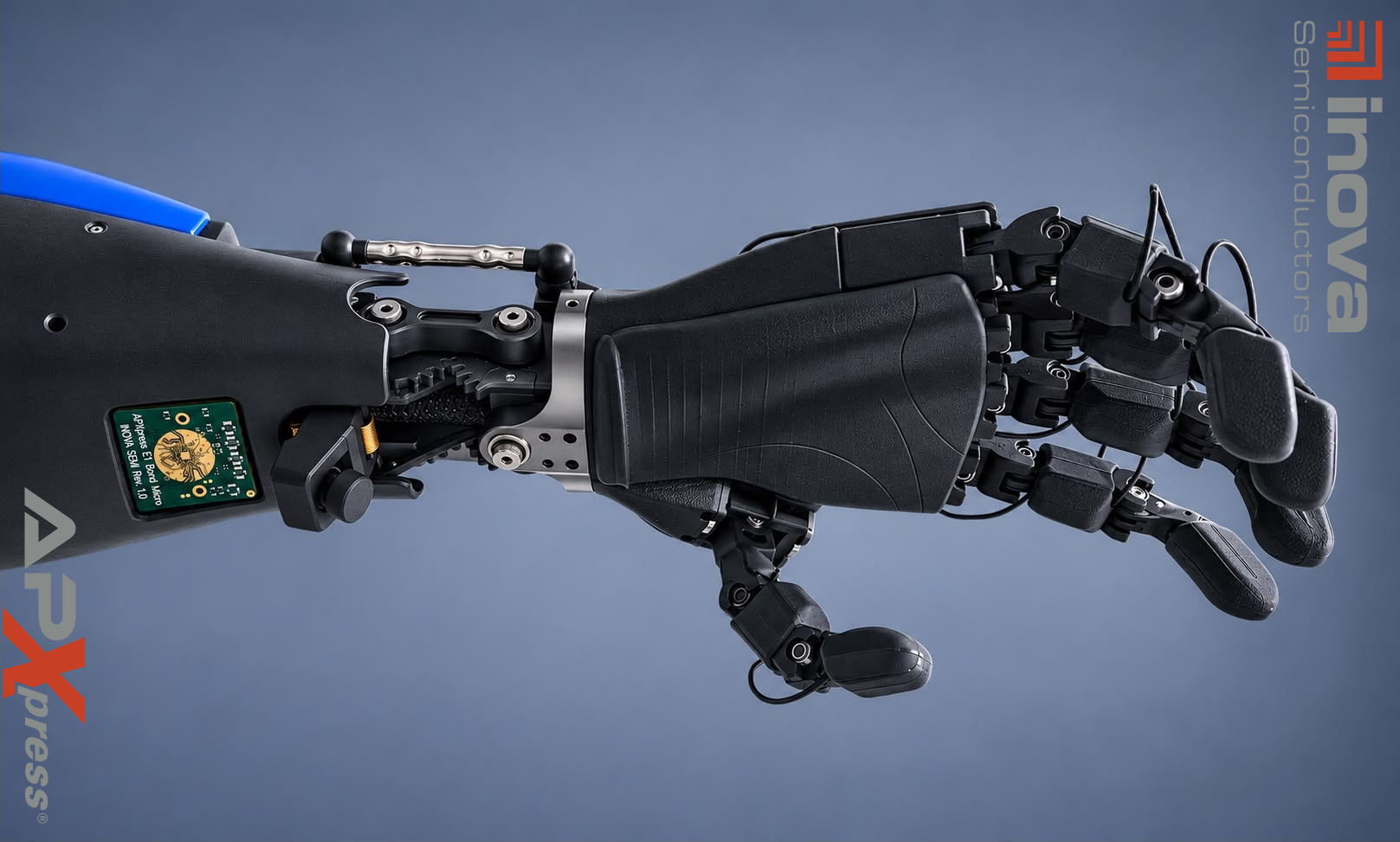
APXpress networking and Lattice FPGAs Nexus™-based close the motion-control loop for 18 motors inside one 10 kHz period, with communication dead time below 10 microseconds. The work is a collaboration with the German Aerospace Center (DLR) Institute of Robotics and Mechatronics as scientific partner.
Munich, Germany, November 9, 2026 – At electronica 2026, Inova Semiconductors is showcasing a development platform for humanoid robots built on Inova’s APXpress high-speed networking technology and low-power Lattice CertusPro™ and Lattice CrossLink™NX FPGAs. DLR’s Institute of Robotics and Mechatronics is the scientific partner in the collaboration, contributing its long-standing research on robotic hands and manipulation.
With that scientific partnership, the control architecture of an 18-motor research hand was reworked so that the motors, the joint sensors, and the tactile array with 10 sensors share one deterministic loop network.
The motion control runs locally at each motor, well above the network rate. Short dead times serve a smooth overall motion control precisely synchronous on all axes to avoid any finger-to-finger skew. To achieve that, the motion controller must sample the sensors and apply current adaptation inside the same control period. The existing solution typically gathers feedback in one period and adapts the current in the next period. Some other solutions not only have a lag of one period but also of two periods. However, minimal lag is crucial for designing stable and safe impedance controllers for human-machine collaboration.
Using early APXpress samples, Lattice Nexus-based FPGAs, and Field Oriented Control from the DLR research, the collaboration runs the motion-control loop inside a single 10 kHz period. Communication accounts for less than 10 µs between sampling the sensor and the setting of new target values with all axes running in synchronicity. A conventional cyclic control process usually applies the command one or potentially even two cycles after the sample. The field-oriented control is implemented on the Lattice FPGA at each motor and runs above this rate.
Joint-angle and tactile sensing use this same network under a separate schedule. Tactile sensing, the bigger part of the traffic, is transferred without interference to the more timing-critical motor control messages. APXpress offers the bandwidth for the robotic hand not needing a separate sensor harness. The motor controllers are connected in a daisy chain with very short wires versus a star architecture requiring more cabling, keeping the hand light and critical mechanical joints free of big wire bundles. The described network topology is also already laid out for cameras, radar, and other perception data streams.
“What makes this project particularly valuable is the excellent collaboration between Lattice, Inova, and the DLR. By combining Lattice’s low-power programmable technology with our APXpress technology, we were able to turn an ambitious concept into a working demonstrator in a very short time. This is precisely the kind of open, engineering-driven cooperation that is needed to bring new architectures for humanoid robotics forward”, said Roland Neuman, CTO of Inova Semiconductor.
Inova is defining the silicon around this modular APXpress network architecture. Each node runs on Lattice CertusPro-NX and CrossLink-NX FPGAs, with application engineering support from Lattice throughout development. DLR remains the scientific partner for the robotic questions, this network is built to serve.