


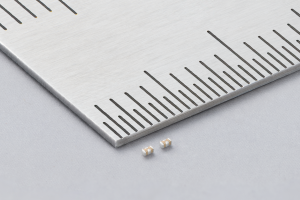
The 0.6 × 0.3 mm capacitors occupy 64% less mounting area than Murata’s previous smallest three-terminal devices.
Murata Manufacturing has begun mass production of its LLD series of three-terminal, low-equivalent-series-inductance multilayer ceramic capacitors in a 0201-inch package.
Measuring 0.6 × 0.3 mm, the components are intended for power-supply decoupling close to high-speed integrated circuits in smartphones, wearable products and other space-constrained electronic systems.
Murata says the new package requires approximately 64% less mounting area than its previous smallest three-terminal MLCC, which used a 0402-inch, or 1.0 × 0.5 mm, format. The company describes the LLD devices as the world’s smallest three-terminal low-ESL MLCCs, based on its research as of 29 September 2026.
Three-terminal capacitors provide four short current paths through the component. This arrangement lowers parasitic inductance compared with a conventional two-terminal capacitor, allowing the device to respond more effectively to rapid changes in current demand at high frequencies.
Reducing ESL is increasingly important as processor and memory supply voltages fall while instantaneous current demand rises. Voltage disturbances caused by switching activity can affect signal integrity and system stability, making the placement and electrical behaviour of decoupling components critical.
Miniaturising a three-terminal capacitor is more difficult than shrinking a conventional MLCC because of its more complex internal and external electrode structure. Murata says it developed an optimised electrode design and associated manufacturing processes to produce the smaller parts.
Two 1 µF versions have entered production. The LLD033R60G105ME01 is rated at 4 VDC and operates from −55°C to +85°C. The LLD033D80E105ME01 is rated at 2.5 VDC and supports operation from −55°C to +105°C.
The smaller footprint gives PCB designers more freedom to place decoupling components directly beside power pins while preserving routing and mounting space for other circuitry. The devices are intended primarily for local power-supply stabilisation around high-speed ICs.
Image credit: Murata Manufacturing


