




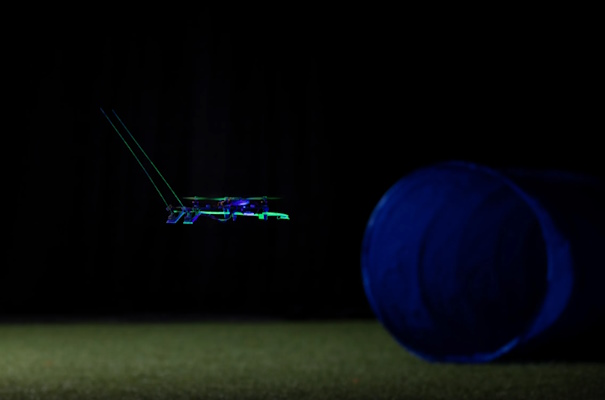
Researchers at Delft University of Technology have developed a lightweight tactile-sensing system that allows a palm-sized drone to navigate by touching its surroundings, rather than relying entirely on cameras, lidar or external positioning.
The bio-inspired system equips a 44.1 g Crazyflie drone with two flexible artificial whiskers. Each whisker consists of a 200 mm-long, 0.4 mm-diameter nitinol wire connected to three miniature BMP390 barometric-pressure sensors. When a whisker bends against a surface, pressure changes at its base provide information about the location and depth of contact.
The complete whisker apparatus weighs 3.2 g. Its sensing, estimation and flight-control software runs onboard an STM32F405 microcontroller with 192 KB of RAM, using 34 KB for the researchers’ algorithms. No external computer or positioning infrastructure is required for tactile perception and navigation.
The work is aimed at micro aerial vehicles operating where optical sensing becomes unreliable. Smoke, dust, darkness, transparent panels and reflective surfaces can all reduce the effectiveness of cameras and laser rangefinders. A compliant tactile sensor can continue to provide local information through gentle physical contact.
Contact without losing stability
Touching an obstacle is particularly difficult for a drone because even a small force applied at the end of a long whisker can create a destabilising moment. The Delft team tested six mounting angles at three wall-following speeds, completing 72 trials. Whiskers positioned at 45 degrees produced the lowest average peak yaw deviation and completed the trials without crashes, while preserving more forward sensing range than the 60-degree configuration.
The sensor must also operate in the airflow generated by the propellers. Temperature changes, vibration and material hysteresis can cause the barometric readings to drift or continue oscillating after contact ends.
To address this, the researchers developed a Tactile Drift Online Recurrent Compensation algorithm. It estimates drift during free flight, filters vibration-induced ringing and prevents contact measurements from corrupting the compensation model. In the reported free-flight experiment, the method reduced the false-positive contact rate to zero under the selected test threshold, compared with 38.24% for band-pass filtering alone and 12.23% for a simpler one-time compensation method.
A neural-network sensor model estimates the depth of contact, while a Kalman filter combines those estimates with a model of the drone’s motion. When tested against whiteboard and transparent acrylic surfaces, the full model produced reconstruction mean absolute errors of 4.12 mm and 5.71 mm respectively.
The researchers found that the tactile system remained usable on transparent surfaces where the comparison time-of-flight laser became noisy or failed when it was not perpendicular to the wall.
Navigation and mapping through touch
In autonomous flight tests, the drone used its whiskers to detect walls, align itself with their surfaces and follow them while maintaining an intended contact depth. It successfully navigated arrangements of three parallel transparent walls and three walls positioned at different angles in five trials for each configuration.
The team also combined tactile wall following with Gaussian Process Implicit Surfaces to explore confined spaces and construct a map from contact measurements. This approach allows the aircraft to treat physical contact as a source of spatial information instead of simply reacting to collisions.
The current system is not a substitute for vision or lidar in every application. It operates at modest speeds, assumes relatively controlled contact geometry and has so far been demonstrated in laboratory environments. The researchers also report greater oscillation and lower reconstruction quality around more strongly curved or moving surfaces.
Its value lies instead in providing a lightweight complementary sensing mode for small drones whose payload, power and computing budgets cannot support extensive perception hardware. Potential applications include inspection, search and rescue, and exploration in dark, smoky, dusty or GPS-denied spaces.
Source:
TU Delft — Bio-inspired whiskers enable tiny drones to navigate in darkness using touch
https://www.tudelft.nl/en/2026
Research paper:
Chaoxiang Ye, Guido de Croon and Salua Hamaza — Whisker-based Tactile Flight for Tiny Drones
https://arxiv.org/html/2510.03
Credit:
TU Delft / Chaoxiang Ye, Guido de Croon and Salua Hamaza