

As hyperscalers race to build ever larger AI infrastructure, processors, networking and cooling often dominate the conversation. Yet behind every GPU cluster lies another critical system-one that rarely attracts headlines but may prove just as essential to the future of artificial intelligence: reliable backup power.
Artificial intelligence is rapidly reshaping the world’s digital infrastructure. What were once conventional cloud data centers are evolving into massive AI factories, housing tens of thousands of high-performance processors operating around the clock. These facilities demand not only unprecedented computing power but also an entirely new level of electrical resilience.
For decades, backup power was treated primarily as an insurance policy against grid failures. In the AI era, however, uninterrupted power is becoming a fundamental design requirement. As electricity consumption rises and power densities continue to increase, the technologies that keep data centers running during outages are attracting growing attention from hyperscalers, utilities and infrastructure suppliers alike.
AI Is Driving an Unprecedented Energy Demand
The global race to develop artificial intelligence has triggered one of the largest infrastructure investment cycles in technology history.
Microsoft, Google, Amazon Web Services (AWS), Meta and OpenAI are collectively investing hundreds of billions of dollars in new AI infrastructure, including hyperscale data centers, advanced networking equipment and specialized computing hardware. Entire campuses designed specifically for AI workloads are being announced across North America, Europe and Asia.
This rapid expansion is transforming electricity demand.
According to the International Energy Agency (IEA), global electricity consumption by data centers could approach 945 terawatt-hours (TWh) annually by 2030, driven largely by AI workloads. That would place data centers among the world’s largest consumers of electricity, comparable to the annual consumption of major industrialized economies.
Unlike traditional enterprise computing, AI training clusters often operate continuously for weeks, while inference services increasingly support millions of users in real time. These workloads create sustained, high-density power demand that extends far beyond historical data center design assumptions.
Did You Know?
The IEA estimates that AI-driven data centers could consume approximately 945 TWh of electricity annually by 2030– more than the current annual electricity consumption of many developed countries.
Reliability Is Becoming as Important as Compute
Generating sufficient electricity is only part of the challenge. Delivering it continuously may prove even more difficult.
AI infrastructure depends on extremely high availability. Even brief interruptions can disrupt large-scale model training jobs that may have been running for days or weeks, interrupt cloud-based AI services or violate strict service-level agreements.
As AI becomes embedded in enterprise software, industrial automation, healthcare, financial services and autonomous systems, tolerance for power interruptions continues to decline.
Consequently, backup power is no longer viewed as a secondary support system. It is becoming an integral component of the computing platform itself.
The emphasis is shifting from simply recovering after an outage to ensuring that critical workloads continue operating without interruption.
Why Diesel Still Dominates
Despite rapid advances in energy technologies, diesel generators remain the dominant backup solution for hyperscale data centers.
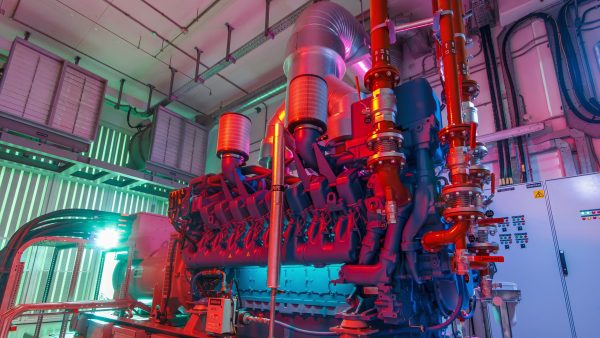
The architecture has changed little over the past several decades. During normal operation, uninterruptible power supply (UPS) systems and battery banks provide immediate power for several seconds or minutes while diesel generators automatically start and assume the electrical load.
The approach is well understood, highly standardized and proven across thousands of facilities worldwide. Diesel systems can deliver large amounts of power for extended periods, provided sufficient fuel is available.
For operators managing mission-critical infrastructure, reliability remains the overriding priority. New technologies may promise lower emissions or reduced operating costs, but they must first demonstrate the same level of dependability under demanding real-world conditions.
Today’s Backup Architecture
- UPS systems
- Short-duration batteries
- Diesel generators
- On-site fuel storage
- Redundant electrical distribution
Sustainability Is Changing the Equation
Although diesel remains the industry standard, environmental and regulatory pressures are beginning to reshape long-term planning.
Many hyperscalers have announced ambitious net-zero commitments, while governments across Europe and elsewhere continue tightening emissions regulations affecting backup generation.
Diesel systems also introduce operational challenges beyond carbon emissions. Fuel storage requires dedicated infrastructure and periodic maintenance, generators must be tested regularly, and local environmental regulations can complicate installation or expansion.
As AI campuses become larger and more geographically distributed, operators are increasingly evaluating how backup power fits within broader sustainability and energy resilience strategies.
The result is not an immediate replacement of diesel, but growing interest in complementary technologies that can reduce emissions while maintaining the reliability expected of critical infrastructure.
The Search for Alternatives
Rather than searching for a single replacement, the industry is exploring a portfolio of backup technologies.
Long-duration battery storage is attracting significant investment as battery costs continue to decline and storage technologies mature. Hydrogen-based power systems and fuel cells are also receiving attention for applications requiring extended runtime with lower direct emissions.
Microgrids are emerging as another important concept, enabling data centers to integrate renewable generation, local energy storage and backup resources into more resilient electrical architectures.
Meanwhile, several companies are developing alternative energy-storage chemistries designed specifically for long-duration backup applications. Among them are aluminum-air systems, which offer high energy density and long storage life for emergency power scenarios.
Industry observers increasingly expect future AI facilities to adopt hybrid backup architectures rather than relying on a single technology.
Tomorrow’s Backup Architecture
- Advanced UPS systems
- Long-duration batteries
- Hydrogen technologies
- Fuel cells
- Microgrids
- AI-driven energy management
- Alternative energy-storage chemistries, including aluminum-air
Hyperscalers Are Already Looking Ahead
Major infrastructure providers are already evaluating how backup power technologies may evolve over the coming decade.
Companies including Google, Microsoft, Schneider Electric and Vertiv are investing in research programs, partnerships and demonstration projects focused on resilient, lower-carbon power infrastructure for future data centers.
Schneider Electric’s Net Zero Innovation Hub, for example, works with emerging technology companies developing solutions that could help reduce emissions across critical infrastructure. Among the participants is Israeli energy-storage company Phinergy, whose aluminum-air technology is being evaluated alongside other approaches that may contribute to future backup power architectures.
While none of these technologies is expected to replace diesel overnight, they illustrate the industry’s growing willingness to rethink one of the least visible-but increasingly strategic-elements of AI infrastructure.
Backup Power Is Becoming Strategic Infrastructure
For years, discussions about AI infrastructure focused primarily on processors, networking and software.
Today, power has become equally strategic.
As AI systems continue to scale, the challenge is no longer simply generating enough electricity. Operators must also ensure that power remains continuously available, resilient and increasingly sustainable.
Backup power is therefore evolving from an emergency safeguard into a core component of digital infrastructure design.
In the next generation of AI data centers, resilience will be measured not only by computing performance, but also by the ability to keep that computing running—regardless of what happens to the grid.
Editorial note: This article was prepared using publicly available information from the International Energy Agency (IEA), industry reports, and announcements from leading technology and infrastructure companies, together with additional editorial research.


