



The PCIe Gen4 reference design combines high-speed USB data with up to 36 W of power delivery per port for industrial machine-vision systems.
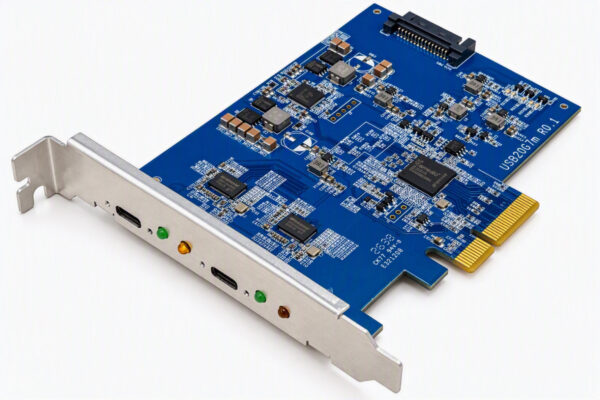
Infineon Technologies has introduced a PCIe Gen4 x4 add-in-card reference design intended to make USB 20 Gbit/s connectivity more practical in industrial machine-vision installations.
The design combines ASMedia’s ASM4242 USB4 host controller with Infineon’s EZ-PD CCG7 USB Power Delivery controller. It provides two USB-C ports, each supporting USB 20 Gbit/s data transfer and up to 36 W of power delivery through 5 V/3 A and 12 V/3 A profiles.
The reference platform is designed to support transmission over five-metre passive USB cables. This addresses a common integration issue in industrial systems, where cameras, sensors and inspection equipment may be mounted several metres from the host computer while still requiring both high bandwidth and local power.
USB 20 Gbit/s, also known as USB 3.2 Gen 2×2, provides twice the bandwidth of 10 Gbit/s USB links. In machine-vision applications, the added capacity can support higher-resolution cameras, faster frame rates and AI-based image processing without requiring separate data and power cabling for every camera.
The ability to supply up to 36 W per port can simplify deployment of advanced cameras by reducing the need for additional local power supplies. Fewer cables and external power units can also make machine installation, maintenance and fault tracing easier in factory and laboratory environments.
The platform is aimed at machine-vision equipment manufacturers, industrial-PC suppliers and system integrators developing cameras and imaging systems for production, inspection and automation applications.
Infineon is presenting the reference design at VISION Stuttgart 2026, where it will demonstrate how high-speed USB can be used for longer industrial connections without moving immediately to more specialised camera interfaces.
Credit: Infineon