




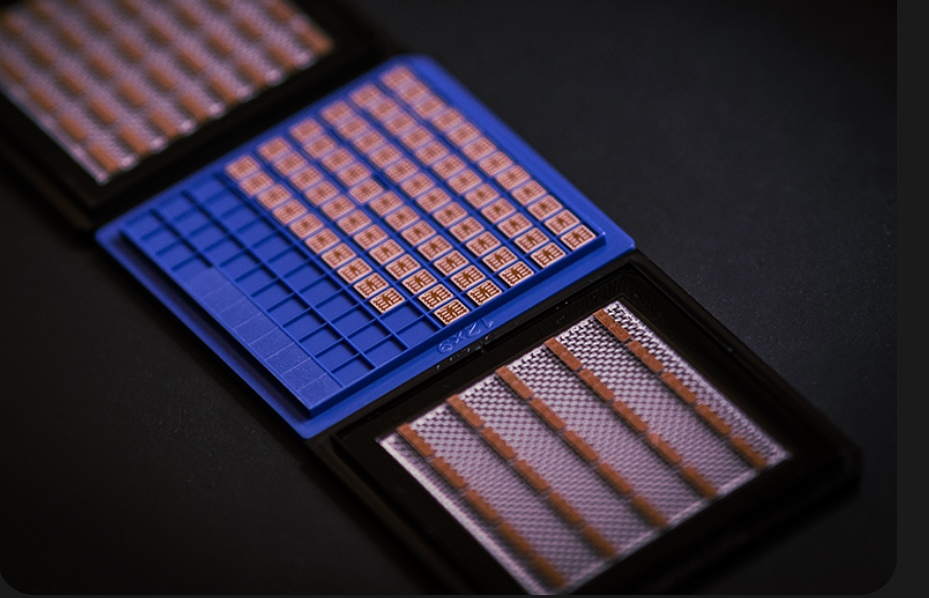
The Belgian semiconductor company is moving its transmit and receive beamformer ICs from prototype production toward commercial volumes for electronically steered satellite terminals.
Belgian semiconductor company TUSK IC has raised €15 million to accelerate commercialisation of its Ka-band beamformer ICs and move the devices from prototype production toward high-volume manufacturing.
The Antwerp-based company is a spinout of KU Leuven’s MICAS research group. Its central engineering proposition is to implement satellite-terminal beamforming in widely available 300 mm bulk CMOS rather than in SiGe or a specialist RF-CMOS technology.
Using a mainstream process could improve the manufacturability and cost structure of the large numbers of RF channels required in flat-panel electronically steered antennas. That could be particularly relevant to user terminals tracking low- and medium-Earth-orbit satellite constellations, where antennas must update their beams continuously as satellites move across the sky.
TUSK’s ConnectKa portfolio includes separate eight-channel transmit and receive beamformer ICs. The TUSK-BC1103-AC transmit device operates from 27.5 to 31 GHz and integrates power amplifiers, signal combining, gain calibration and SPI control. It provides 360-degree phase control with steps below 5.625 degrees and a 33 dB gain range with six-bit resolution.
The TUSK-BC2103-AC receive beamformer covers 17.7 to 21.2 GHz. It also provides eight channels and 360-degree phase control with resolution below 5.625 degrees, together with a 31 dB gain-adjustment range. Both beamformers can store as many as 128 programmable beam states.
The portfolio also includes the dual-channel TUSK-LN0101-AC low-noise amplifier for the 17.7 to 21.2 GHz receive band. TUSK specifies a noise figure as low as 1.5 dB and gain of 20 dB, although the company has not published complete test conditions or production-characterisation data for the portfolio.
TUSK says it is working with an unnamed satellite-communications manufacturer to integrate the technology into a new electronically steered array. The company also received an ESA ARTES contract earlier in 2026, supported by Belgium’s BELSPO, to advance the technology.
The Series A round was led by Matterwave Ventures, FORWARD.one and the Flanders Future Tech Fund, managed by PMV. TUSK says the financing will support the transition from prototype chips to high-volume production.
That wording is important. Although TUSK describes the devices as production-ready, it has not disclosed its foundry, fabrication node, qualification status, pilot yield, customer identity or a date for sustained volume output. The €15 million round funds the move toward industrial scale; it does not mean high-volume manufacturing has already begun.
If the beamformers can meet performance, power and reliability requirements in standard bulk CMOS, the approach could reduce one of the cost barriers to electronically steered satellite antennas. The next decisive milestones will be customer qualification, measured antenna-level performance and confirmed production output.
Sources:
TUSK IC Series A announcement
TUSK IC Ka-band product information
Credit: TUSK IC