

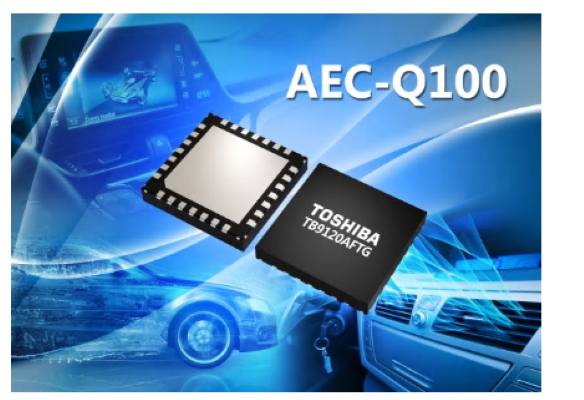
TOKYO—Toshiba Electronic Devices & Storage Corporation (“Toshiba”) has launched the“TB9120AFTG,” a constant-current 2-phase stepping motor driver for automotive applications. The new IC outputs a sine-wave current using only a simple clock input interface, with no need for an advanced functional MCU or dedicated software.
TB9120AFTG was developed as a successor to TB9120FTG, introduced in 2019 as Toshiba’s first automotive stepping motor driver, and provides improved noise resistance. TB9120AFTG incorporates DMOS FETs with low on-resistance (upper + lower = 0.8Ω (typ.)), which achieve a maximum current of 1.5A[1]. Both the DMOS FETs and the controller that generates micro-stepping sine waves (supporting up to 1/32 steps) are housed in a small QFN type package (6.0 mmx6.0 mm).
The new IC delivers an operating temperature range of -40 to 125℃, and meets AEC-Q100, a certified standard for electronic components for automotive applications. It is suited to a wide range of automotive general applications using stepping motors, such as adjustment of the projection position of heads-up displays, and in the expansion valves of refrigerant circuits.
Key features
General multipurpose specifications, especially for automotive applications
- DMOS FETs with low on-resistance (upper + lower = 0.8Ω (typ.)), which achieve a maximum current of 1.5 A.
- Built-in error detections with warning signal output function: Over-current detection, thermal shutdown, and load open.
- Housed in a wettable flank VQFN package (6mm×6mm) with excellent solderability
- Operating temperature range: -40℃ to 125℃
- AEC-Q100 qualified
Micro step drive, supporting up to 1/32 steps.
- Less motor noise, smoother and more precise control
- Uses only a simple clock input interface, with no need for an advanced functional MCU or dedicated software.
- Constant-current PWM control: Mixed decay mode stabilizes current waveforms.
Stall detection function
- A stall detection signal is output from SD pin after detecting a stall.
- The detection signal can be received by a microcontroller and fed back to the system.
Applications
- Mirror adjustment for the projection position of heads-up displays
- Expansion valves in refrigerant circuits for automotive air conditioners and battery management systems


