


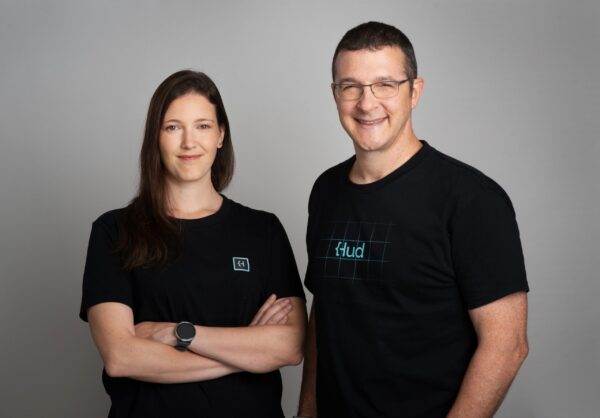
Hud automatically captures live service and function-level data from production- providing the missing context for AI to detect and fix issues, and to build production-safe code.
Hud today announced the launch of its Runtime Code Sensor, the world’s first platform designed to provide real-time, function-level production insights to both software engineers and AI coding agents.
Enterprises face mounting pressure to adopt AI development tools, yet struggle to bridge the gap between AI’s promises and code that performs reliably in production at scale. Capgemini Research Institute found that even as 60% of organizations experiment with generative AI pilots, 75% struggle to scale them to production—calling it a “significant challenge.”
This fundamental trust issue prevents broader adoption beyond pilot programs. In fact, 28% of executives ranked lack of trust in AI agents as a top-three challenge, according to a recent PwC survey. Organizations need to know that their AI generates code that takes their production realities into account and does not introduce errors or regressions. As AI tools generate code at unprecedented speed and scale, companies require better guardrails to safely harness this technology without compromising operations.
Even before the age of AI code generation, and despite existing observability tools, systems often fail in surprising ways in complex production environments. Existing logs and traces provide only partial insight into the past, require manual maintenance as the codebase evolves, and most importantly aren’t designed for models to reason about the future.
Hud was built from the ground up for the AI code generation revolution, automatically and dynamically providing both engineers and agents with the production context they need to build code that excels in real-world environments, not just local theory.
Hud’s Runtime Code Sensor delivers proactive production awareness, moving beyond reactive monitoring approaches. The lightweight software sensor continuously captures live function-level behavior, including performance metrics, errors, execution flows, and dependencies, without requiring logs, traces, or manual instrumentation. It connects in real-time between service-level issues and function-level root causes, gathering and serving the granular context needed to resolve issues as they occur.
With installation taking just one minute and requiring zero configuration or maintenance, the sensor already runs across millions of services in massive production environments with negligible overhead.
Built from first principles for AI consumption, the platform automatically captures the service-level and function-level data that LLMs need to understand how code behaves in the real world. This capability enables AI coding agents to make informed decisions based on actual production behavior rather than assumptions, dramatically improving the safety and reliability of AI-generated code.
“Every software team building at scale faces the same fundamental challenge: building high-quality products that work well in the real world,” said Roee Adler, CEO and Founder of Hud. “In the new era of AI-accelerated development, not knowing how code behaves in production becomes an even bigger part of that challenge. Our Runtime Code Sensor transforms the feedback loop between development and production, ensuring immediate validation and optimization of software code – whether human-written or AI-generated.”
Comprehensive Production Intelligence Platform
Hud’s platform delivers production intelligence through multiple integrated capabilities designed for modern development workflows:
- Runtime Code Sensor: Lightweight software sensor that captures live function-level behavior, performance metrics, errors, and execution paths with one-minute installation, zero configuration, and negligible overhead
- IDE-Integrated Runtime Visibility: Real-time production intelligence embedded directly into developer IDEs (VS Code, JetBrains, Cursor), surfacing actionable insights precisely where code is authored without context switching
- MCP Server: Structured production insights delivered directly to AI coding agents (supports Cursor, Copilot, Claude and most CLI agents), enabling production-aware code generation based on actual live behavior
- Automatic Root-Cause Identification: Continuous detection of production errors and degradations with immediate alerts containing specific root causes and the context needed for rapid resolution by both human engineers and AI agents
- Self-Healing Production Orchestration: When issues are detected, Hud uses the granular root cause context to assess different possible approaches, find a low risk, high impact solution, run tests and have it ready for the user to review and open a PR – saving
“Hud delivers runtime insights that not only keep us confident in safely shipping to production, but also let us tackle performance and error rates at the function level,” Daniel Marashlian, CTO and Co-Founder, Drata. All of that data allows us to supercharge our agentic coding practices via the Hud MCP server and helps our teams move faster.”
“Hud delivers function-level observability out-of-the-box without paying for ingested spans on everything, unlike traditional APMs that only observe endpoints and have alerts that only tell us that something is wrong, but not why it happened. With Hud we just get all of this information for all functions, even for underlying packages.” says Moshik Eilon Group Tech Lead at monday.com. “In a complex system like ours, Hud eliminated our voodoo incidents – like mysterious CPU spikes that required custom profiling tools and days of investigation. Now engineers ask Cursor ‘why is this endpoint slow?’ or ‘why is the CPU spiking on pod xyz?” and get immediate, deployment-correlated answers. AI-powered root cause analysis turned days of drilling through tools into minutes.
To date, Hud has secured $21M in funding, underscoring its position as a leader in making AI-driven development workflows safe and scalable in production, as its Runtime Code Sensor gains adoption across enterprise environments and empowers engineers and AI coding agents to build production-safe software at scale
Hud detects errors and performance degradations in production with the deep forensic context needed to fix them with AI. Founded by serial entrepreneurs with extensive experience in operating systems and cybersecurity, Hud built the Runtime Code Sensor – a lightweight sensor that runs alongside application code and continuously captures function-level behavior with negligible overhead.
By structuring real production behavior for both engineers and AI coding agents, Hud provides the runtime intelligence needed to understand issues faster, improve reliability, and adopt agentic development safely. Today, the Runtime Code Sensor already runs across millions of services in large-scale production environments and is becoming foundational infrastructure for teams bringing AI into real software workflows.
Learn more at www.hud.io
Credit: Ben Itzhaki


