




Technology cuts costs, increases output, and reduces emissions for U.S. industries
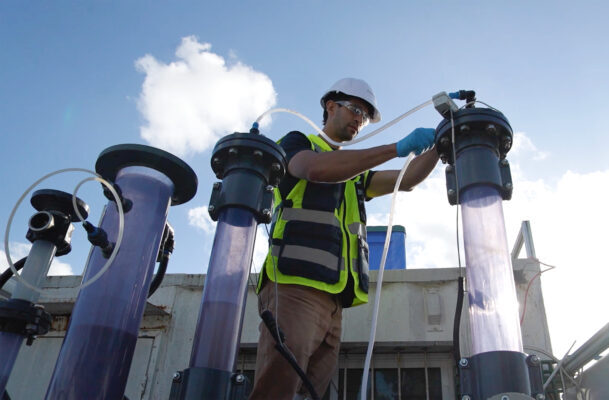
CarbonBlue, a climatech startup, has demonstrated a new way to improve industrial operations by removing carbon dioxide (CO₂) from water. The company today announced the installation of its “Midway” pilot project in a brackish water desalination facility in Ma’agan Michael, Israel, enabling reduced costs and higher productivity while simultaneously lowering carbon dioxide levels in the atmosphere. The technology offers a practical approach for water-utilizing U.S. industries like desalination, energy, and manufacturing to meet climate goals while improving performance.
Dr. Dan Deviri, Co-founder and CEO of CarbonBlue, said: “We found that by removing CO₂ from water, we can cut costs, improve operational efficiency, and reduce carbon footprints, all at the same time.”
How It Works
CarbonBlue’s system uses a chemical reactor to pull CO₂ from any type of water—whether from industrial water streams, brines, groundwater or natural water bodies. CO2 dissolved in water quickly reacts with lime to form high-quality precipitated calcium carbonate (PCC), an important feedstock in various industries. CarbonBlue’s technology allows for PCC’s production Stateside, boosting the economy and manufacturers, and bolstering independent American value chains. When exposed to the atmosphere, the decarbonated water can reabsorb atmospheric CO2, thereby lowering the industry’s carbon footprint.
In the pilot’s first phase, the system will process 10% of the desalination facility’s saline water intake, removing 40 metric tons of CO₂ per year. Following this initial testing period, the facility will be scaled up to 100% of the desalination plant’s water inlet stream, removing over 400 tons of CO2 per year, with future plans to scale to tens of thousands of tons per facility, and millions of tons in combined operations. For the desalination plant, Midway will prevent scaling, extend membrane lifetime, and increase produced water volume for use by both the local community and the national water grid. The technology is similarly beneficial to any water-utilizing infrastructure; with U.S. industries using massive amounts of water annually, this approach could address a significant market, and significantly impact the world’s carbon balance.
Benefits for Industry and Environment
The technology lowers operating costs for facilities like cooling towers, power plants, desalination and other water-using industries, and generates a new revenue source by selling high-quality calcium carbonate and providing decarbonization benefits. Early interest from U.S. energy and manufacturing companies suggests potential for job growth and climate- and business-critical improvements in industrial efficiency.
“U.S. firms are already exploring how our system can fit into their existing plants,” Deviri said. “It’s a straightforward way to reduce carbon footprints and improve efficiency without disruptive changes to traditional industrial processes and infrastructure.”
Why Water?
Founded in 2022 by CEO Dr. Dan Deviri, a physicist from the Weizmann Institute of Science, and COO Iddo Tsur, CarbonBlue chose to focus on water-based carbon removal when they realized CO₂ concentrations in water are more than 100 times higher than in the air, and that removing CO2 from water is essentially equivalent to removing it from the atmosphere because of the natural balance between the two. Coupled with water’s ubiquity and extensive infrastructure and utilization, water-based removal felt like a promising solution. “We saw water as the smarter path to scale carbon removal,” Deviri explained.
The World Economic Forum notes that only 41 megatons of CO₂ were removed globally in 2023, far below the 1–1.5 gigatons needed annually for net zero by 2030–2035. The carbon removal market, worth $3.4 billion in 2024, is expected to grow to $25 billion by 2029, a 49% annual growth rate. CarbonBlue’s technology could help meet this demand.
A Step Toward Cleaner Industry
The Midway project highlights how CarbonBlue’s technology can make industries more efficient and sustainable. From California’s desalination plants to Midwest factories, it offers a way to align with net-zero goals while improving profitability.
Images, video and further information can be accessed here.


