

Predicting the future adoption of robotics is a challenging task. However, the history of the computer industry offers valuable analogies that help us understand the current state of robotics and where we are heading. Just like early computers, robots today are primarily hardware with low-level software, requiring specialized engineering knowledge and time-consuming preparations for each task.
Initially, only large businesses could afford to purchase and operate computers—banks being one of the few industries that adopted mainframes and knew how to make use of them when these first products appeared on the market.
In the case of robotics, current hardware is already mechanically capable of performing a wide range of activities that are still carried out manually today. So, if that’s the case, why aren’t robots doing most of that work already? There are two main reasons:
- Challenges in Human-Robot Interaction (HRI):
Even though the hardware and basic software exist, the intelligence does not. Current software does not allow general users—those without a technical background—to request, define, operate, or adjust robotic tasks on demand. Instead, each implementation still requires extensive effort by technical teams. Moreover, if changes are needed later—as is often the case today—the engineering team must again be involved, and more time is required for customization. Autonomy is also lacking: most robots still require custom-made software to specify each individual 3D coordinate of the trajectory they must follow. - Cost Barriers:
Like any other technology in its early stages, cost is a significant hurdle. An industrial robotic arm or a cobot from a reputable manufacturer today costs approximately US$25,000. After adding peripherals and technical services, a full implementation might cost up to four times that amount. While such costs may be feasible for some industries, they are out of reach for most small- and medium-sized businesses—and certainly for home users.
So, when will the widespread adoption of robotics begin? I believe it will happen within the next seven years, driven primarily by emerging solutions that focus on easy-to-use, high-level software platforms and enhanced autonomy. These platforms enable robots to learn from simple demonstrations by end users—similar to how humans learn tasks.
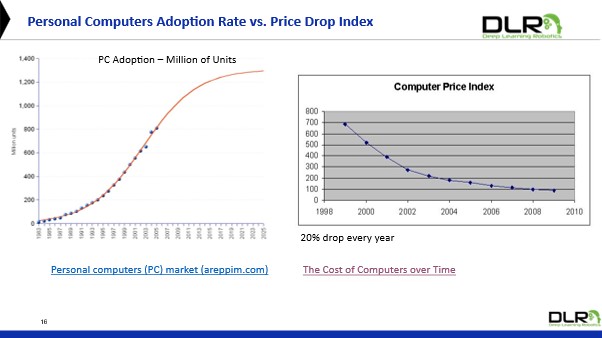
If we draw an analogy to the computer industry, the graph below illustrates how adoption skyrocketed after the advent of the first personal computers—and how prices dropped proportionally:
*Sources:
https://stats.areppim.com/stats/stats_pcxfcst.htm,
http://www.freeby50.com/2009/04/cost-of-computers-over-time.html
As Microsoft and Apple simplified the user interface, they made computers accessible to non-technical users, which dramatically accelerated adoption. As adoption grew, prices fell.
Similarly, the adoption of AI-powered robotic arms is poised to revolutionize both industry and everyday life—just as the personal computer did decades ago. As technologies that enable robots to learn from human demonstrations become more prevalent, the range of tasks robots can perform will expand significantly. This will lower the barriers to entry and make robotics accessible to a much broader segment of the population.
Deep Learning Robotics (DLRob), is at the forefront of this transformation. Our company holds multiple broad-scope patents in the field of self-trained robots and robots that learn from human demonstration—core technologies that will define the next generation of automation, or as we like to define it, the automation of automation.
The “PC moment” of robotics is just around the corner, and its impact will be both profound and far-reaching.


