If you add quantum dots – nanocrystals 10,000 times smaller than the width of a human hair – to a smartphone battery it will charge in 30 seconds, but the effect only lasts for a few recharge cycles.
However, a group of researchers at Vanderbilt University report in the Nov. 11 issue of the journal ACS Nano that they have found a way to overcome this problem: Making the quantum dots out of iron pyrite, commonly known as fool’s gold, can produce batteries that charge quickly and work for dozens of cycles.
Cary Pint and Anna Douglas examining the recharge rate of one of their modified batteries. (John Russell / Vanderbilt)
The research team headed by Assistant Professor of Mechanical Engineering Cary Pint and led by graduate student Anna Douglas became interested in iron pyrite because it is one of the most abundant materials in the earth’s surface. It is produced in raw form as a byproduct of coal production and is so cheap that it is used in lithium batteries that are bought in the store and thrown away after a single use.
Despite all their promise, researchers have had trouble getting nanoparticles to improve battery performance.
“Researchers have demonstrated that nanoscale materials can significantly improve batteries, but there is a limit,” Pint said. “When the particles get very small, generally meaning below 10 nanometers (40 to 50 atoms wide), the nanoparticles begin to chemically react with the electrolytes and so can only charge and discharge a few times. So this size regime is forbidden In commercial lithium-ion batteries.”
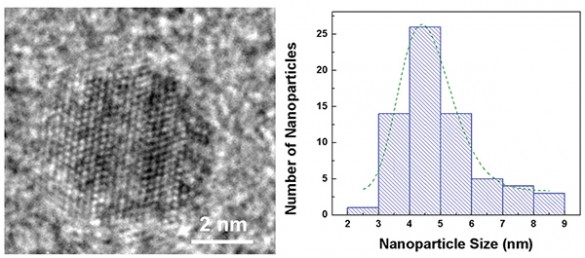
Aided by Douglas’ expertise in synthesizing nanoparticles, the team set out to explore this “ultrasmall” regime. They did so by adding millions of iron pyrite quantum dots of different sizes to standard lithium button batteries like those that are used to power watches, automobile key remotes and LED flashlights. They got the most bang for their buck when they added ultrasmall nanocrystals that were about 4.5 nanometers in size. These substantially improved both the batteries’ cycling and rate capabilities.
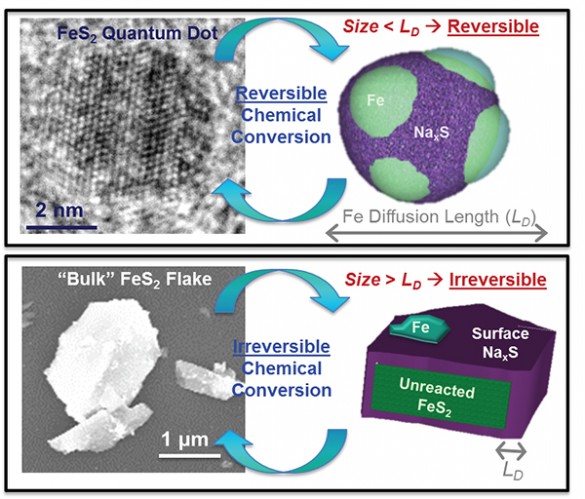
Putting bulk iron pyrite in a battery works poorly because the iron must move to the surface so that sodium-sulfur material (or lithium-sulfur material) can form and store energy. Iron pyrite quantum dots, by contrast, have iron close to the surface due to their small size, and this energy storage process can occur reversibly over many cycles. The diffusion length (LD) represents the distance iron atoms have to move through the iron pyrite to reach the surface. (Pint Lab / Vanderbilt)
The researchers discovered that they got this result because iron pyrite has a unique way of changing form into an iron and a lithium-sulfur (or sodium sulfur) compound to store energy. “This is a different mechanism from how commercial lithium-ion batteries store charge, where lithium inserts into a material during charging and is extracted while discharging – all the while leaving the material that stores the lithium mostly unchanged,” Douglas explained.
According to Pint, “You can think of it like vanilla cake. Storing lithium or sodium in conventional battery materials is like pushing chocolate chips into the cake and then pulling the intact chips back out. With the interesting materials we’re studying, you put chocolate chips into vanilla cake and it changes into a chocolate cake with vanilla chips.”
As a result, the rules that forbid the use of ultrasmall nanoparticles in batteries no longer apply. In fact, the scales are tipped in favor of very small nanoparticles.
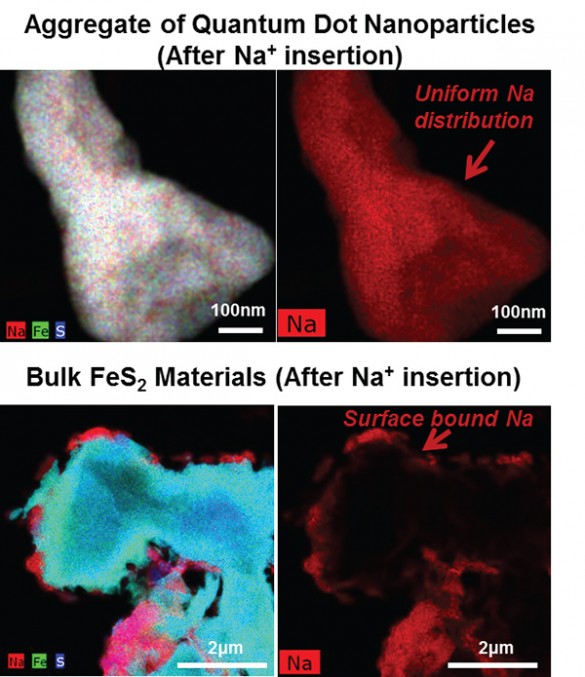
Elemental maps showing the distribution of elements in a cluster of quantum dot nanoparticles (top) and a bulk FeS2 particle (bottom) after sodium is inserted into the material, or after it is being “charged” with sodium. The sodium inserting in the material is the basis for its energy storage capability. The uniform distribution of sodium in the quantum dot cluster represents a better energy storage capability than the bulk material, where the sodium can only reach the surface of the material. This trend and observation also holds true for lithium storage. (Pint Lab / Vanderbilt)
“Instead of just inserting lithium or sodium ions in or out of the nanoparticles, storage in iron pyrite requires the diffusion of iron atoms as well. Unfortunately, iron diffuses slowly, requiring that the size be smaller than the iron diffusion length – something that is only possible with ultrasmall nanoparticles,” Douglas explained.
A key observation of the team’s study was that these ultrasmall nanoparticles are equipped with dimensions that allow the iron to move to the surface while the sodium or lithium reacts with the sulfurs in the iron pyrite. They demonstrated that this isn’t the case for larger particles, where the inability of the iron to move through the iron pyrite materials limits their storage capability.
Pint believes that understanding of chemical storage mechanisms and how they depend on nanoscale dimensions is critical to enable the evolution of battery performance at a pace that stands up to Moore’s law and can support the transition to electric vehicles.
“The batteries of tomorrow that can charge in seconds and discharge in days will not just use nanotechnology, they will benefit from the development of new tools that will allow us to design nanostructures that can stand up to tens of thousands of cycles and possess energy storage capacities rivaling that of gasoline,” said Pint. “Our research is a major step in this direction.”
A transmission electron microscope image of a single iron pyrite quantum dot on the left and a graph that shows the size distribution of the fool’s gold quantum dots that they added to standard lithium batteries. (Pint Lab / Vanderbilt)
Coauthors of the paper with Pint and Douglas include mechanical engineering graduate students Rachel Carter and Adam Cohn and interdisciplinary materials science graduate students Keith Share and Landon Oakes. The research was funded in part by National Science Foundation grant EPS 1004083 and NSF’s graduate research fellowship program grant 1445197.
Companies commercialize scale manufacturability of 800G to 1.6T PICs in external pluggable and CPX MSA…
Samtec, Inc., the service leader in the connector industry, announces the release of its 1.0…
LaFontaine’s 40+ locations across Michigan will bring UVeye’s “MRI for Cars” technology closer to drivers…
After 3 years of development by alumni of TikTok and Google, the Israeli startup is…
The planned acquisition will combine Analog Devices’ sensing, signal-processing, power and connectivity technologies with Alif’s…
A locally applied laser-annealing process enabled the researchers to crystallise magneto-optical garnet without exposing the…