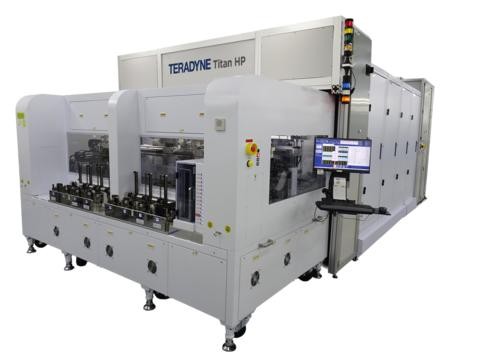
Teradyne’s Titan HP combines realistic device workloads, per-device junction-temperature control and a traceable stress history, highlighting the new demands that power-hungry AI accelerators place on semiconductor test engineering.
The arrival of AI accelerators in data centres is changing more than semiconductor design. It is also changing the conditions under which devices must be tested before shipment. For a processor intended to operate at high load for extended periods, verifying that its functions work is only part of the task. Engineers must also understand what happens as power dissipation, temperature and software activity fluctuate throughout prolonged operation.
In October 2026, Teradyne announced expanded burn-in capabilities for its Titan HP system-level test platform. According to the company, the system can hold each device at a target junction temperature while executing a realistic workload, allowing the same platform to be used for system-level testing (SLT) or reliability stress testing. This is not a replacement for every other test stage. It is a response to the increasingly difficult conditions confronting test infrastructure for advanced processors.
Burn-in is intended to expose early-life failures by operating devices under defined stress conditions, often for hours. It has never been a purely passive process: conventional schemes can also exercise devices electrically and monitor their behaviour. The difference is that, as devices become more powerful and complex, setting a uniform air temperature around a group of parts becomes a less reliable indication that each device is experiencing the intended stress.
An AI accelerator can change its power draw quickly as compute units, memory subsystems and data interfaces move between operating states. The resulting heat varies as well. Neither the temperature of the air surrounding a device nor a single measurement inside the test fixture necessarily reflects the temperature at its semiconductor junction. The engineering question is whether consistent stress can be maintained even while the device workload is changing.
The gap between ambient and junction temperature is familiar from thermal design. Heat must travel from active silicon through the package, thermal interface materials, cooling system and surrounding environment. Each part of that path introduces thermal resistance. A change in power therefore changes junction temperature even when the room or chamber temperature remains unchanged.
Advanced packages containing multiple dies or chiplets further complicate the picture. Power distribution may be highly uneven: one part of a package may operate intensively while another remains lightly loaded. Local hot spots can persist even when the temperature at a designated measurement point appears controlled.
This matters in reliability testing because failure mechanisms can depend on temperature, voltage and the duration of exposure. If stress conditions differ between devices or drift during a test, comparisons across production lots become harder. An observed difference may reflect the component, the test environment or both.
Teradyne’s approach on Titan HP is based on independent thermal control at each test site. The company says it can run a workload on each device while maintaining a specified junction-temperature target, rather than relying primarily on a common ambient temperature. Thermal control is also tailored to the device’s thermal and clamping zones.
When the platform was introduced in October 2025, Teradyne described several relevant design features: a multi-branch cold plate for cooling both the device under test and other components; asynchronous proportional-integral-derivative (PID) control tuned at each site; and an optional device heater. Together, cooling and heating offer a way to respond as dissipated power rises or falls.
The control algorithm is only one part of the equation. Contact quality between package and fixture, heater and cooler response times, and temperature sensing or estimation all influence actual test conditions. Publicly available descriptions do not specify how junction temperature is measured or estimated, or provide control-accuracy figures across the full operating envelope. Those details would be needed for a quantitative assessment, particularly where results must be compared across devices and test runs.
Power-hungry AI accelerators also require an electrical supply designed for substantial current. At high currents, even small resistances in the power path create voltage drop and dissipate heat. Rapid load changes can introduce supply transients, while interconnect heating can influence stability and repeatability.
The headline maximum power rating therefore tells only part of the story. Engineers need to examine voltage regulation at the device, transient behaviour and protective responses under abnormal conditions. In its 2025 announcement Teradyne specified support for up to 2 kW per device and a roadmap towards 4 kW; its current product description refers more generally to kilowatt-level per-device delivery and a roadmap aligned with rising accelerator requirements. The proposed higher figure should not be mistaken for a demonstrated present capability.
Electrical and thermal conditions are coupled. A higher workload increases heat generation, while device temperature can in turn affect leakage current and power-management behaviour. Recording both sets of conditions helps distinguish an actual device response from a change in the surrounding test system.
A central point in the October 2026 announcement is the option to use one platform for either SLT or reliability testing. SLT exercises devices in an environment approximating their intended operation, often involving software execution, memory access, interfaces and communication with other components. It may uncover faults that narrowly focused electrical or functional tests miss.
Burn-in serves a different purpose: exposing early failures through a defined period of stress. A realistic workload can make the stress more representative of actual operation. But an SLT sequence does not automatically qualify as burn-in, and not every functional workload is an appropriate stress profile. A reliability programme must define stress levels, exposure time and acceptance criteria for the device and failure mechanisms under investigation.
Teradyne says test programmes run through its Atlas software environment, which supports importing existing routines, developing new ones and moving programmes to other Teradyne SLT systems. That may simplify programme management, but the extent of portability depends on the configuration, application and precise stress profile.
In volume manufacturing, test duration is an operational and economic constraint. Burn-in can take hours, while other test stages finish far sooner. If all sites in a system operate as one group, a long run on one device may restrict loading or maintenance elsewhere.
Titan HP employs independently operating slots. Teradyne says an individual device can be loaded, tested or serviced while other sites continue operating. This could reduce system downtime and improve equipment utilisation when devices or programmes have different cycle times. Actual throughput, however, still depends on the number of working sites, test duration, cooling and power capacity, and the handling equipment feeding and unloading devices.
Test energy consumption matters too. Running several high-power devices simultaneously requires substantial electrical and cooling infrastructure. Teradyne points to potential savings in test cost, floor space and time to market; without published comparative measurements, the scale of those gains cannot be established for a particular factory.
The company also emphasises a consolidated record of each device’s stress and test history. In an advanced manufacturing flow, knowing only that a component passed or failed is not always sufficient. When a fault appears, engineers may need to reconstruct which workloads were applied, what thermal and electrical conditions prevailed and how the component behaved throughout the process.
Linking stress profiles with test results can support comparisons between production lots and help identify patterns associated with later failures. Data retention alone, however, does not establish failure causation or provide predictive reliability. Measurement quality, traceability across manufacturing stages and appropriate analytical methods remain essential.
The challenge posed by high-power AI silicon is not simply supplying more electricity or removing more heat. Test engineers must create reproducible stress conditions for devices whose electrical and thermal behaviour changes dynamically under load.
Titan HP illustrates an approach that brings workload execution, junction-temperature control and test-data management together. It does not remove the need for additional reliability assessments or device qualification. Rather, it addresses some of the limitations that appear when traditional test flows are applied to modern accelerators. For test engineers, the key question remains practical: can each device be subjected to the specified stress profile, can the actual conditions be measured, and can those conditions be reproduced throughout production?
Teradyne, “Teradyne Unveils Titan HP,” 2 October 2025.
Teradyne, “Teradyne Introduces Titan HP Platform with Burn-In Capabilities for Advanced AI Data Center Devices,” 6 October 2026.
Teradyne, Titan HP product overview, 2026.
Following functional validation of a 22 nm FD-SOI prototype, Fraunhofer is offering a RISC-V and…
Synaptics’ Astra SR200 family combines heterogeneous Arm cores, Torq neural acceleration and package-integrated DRAM to…
Belgian research institute imec has demonstrated a Ge/Si avalanche photodiode combining 100 GHz bandwidth, 1.8…
Tessenderlo-Ham, Belgium, 11 November 2026 – Melexis introduces the MLX90636, the world’s smallest contactless temperature…
Hi-rel connectors and components backed by in-depth product knowledge Powell Electronics Europe, the supplier of…
Founded nine months ago, Bay is already trusted by dozens of enterprises to control AI…