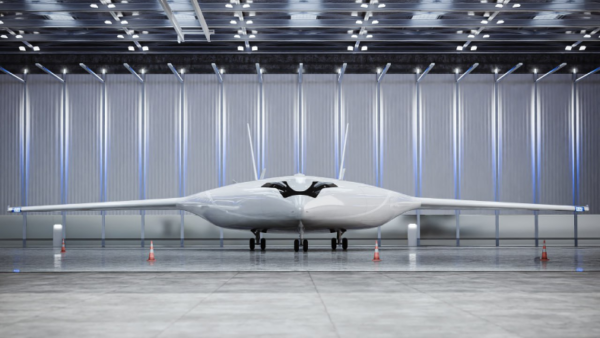
Natlius uses Siemens Xcelerator software portfolio to design aircraft with 1.5x more cargo capacity that uses 50% less fuel
Siemens showcases collaboration with Natilus at Farnborough International Airshow
Siemens Digital Industries Software announced today that Natilus, an aerospace company based in the United States, has adopted the Siemens Xcelerator portfolio of industry software. The company is focused on transforming the world’s supply chain with its next-generation blended-wing-body aircraft, and through its use of Siemens software it has reduced the development time to build its first prototype aircraft by 50%.
Founded in 2016 by Aleksey Matyushev and Anatoly Star, Natilus aims to commoditize the freight transport industry through innovation and advanced technology. Natilus’ blended-wing body design ‘Diamond’ cargo bay is planned to offer 1.5 times more cargo capacity than current cargo aircraft while consuming 50% less fuel. These innovative aircraft represent a quantum leap in operational economics, increasing revenue in the hyper competitive cargo freight industry.
“Siemens’ immersive technology is revolutionizing how we develop our next-generation aircraft. It’s not just about seeing the design; it’s about experiencing it in a way that enhances our engineering decisions and accelerates innovation,” said Aleksey Matyushev, CEO, Natilus. “Our work with Siemens and our adoption of the Siemens Xcelerator portfolio allow us to achieve the speed with which innovation needs to occur and helps us to remain agile, flexible and reactive as we strive to meet customers’ demands for next generation, sustainable aircraft.”
“Natilus is setting the benchmark for the power of digital transformation and agility in the aerospace industry, and we’re delighted that it has selected Siemens as a trusted partner to help them achieve their mission of reinventing the global air cargo industry,” said Todd Tuthill, vice president for Aerospace and Defense, Siemens Digital Industries Software. “We look forward to working with the team as they bring their innovative new aircraft to market – it’s another excellent example of how innovators and pioneers are adopting Siemens Xcelerator and our aerospace digital threads to help them build a more sustainable aviation industry.”
Natilus has adopted NX™ X software for aircraft engineering and Teamcenter® software for Product Lifecycle Management (PLM) from the Siemens Xcelerator portfolio of industry software. Natilius uses NX X for the highly complex surface design and mechanical engineering capabilities required for this fast-paced project. Because NX X is delivered through the cloud as part of Siemens Xcelerator as a service, Natilus is able to protect its mission critical intellectual property while enabling agile collaboration on design and engineering tasks with its geographically dispersed development team.
Bringing the aircraft to the customer with immersive design
Natilus has been an early adopter of NX immersive designer, where they combine the real and digital worlds using the new Sony XR Head Mounted Display. Featuring precise 3D interaction, stunning visual fidelity and seamless collaboration the Natilus team can travel with all the tools they need to provide clients and potential customers with the full immersive experience firsthand.
“When it comes to building next-generation aircraft, there is immense value in taking a model from a 2D screen to a full-scale 85-foot wingspan digital twin in our hangar. We’ve been able to experience this thanks to the power of the Siemens “industrial metaverse” as one of the first companies selected to use the advanced Sony headset and augmented reality software. This technology is making immersive design a reality and enabling collaborative product engineering capabilities and customer engagement that weren’t possible before,” said Matyushev.
“One of Natilus’ key challenges is showing customers the exact breadth and depth of the products we are building. While engineers can see individual pieces in the hangar to develop a partial idea of the design, putting all together in an immersive engineering environment allows customers to understand the entire design at scale. This type of technology is part of our story to help make those sales and keep conversations with customers really energetic. Our development pace is skyrocketing with this collaboration as we work hand-in-hand with these innovative companies to shape the future of aviation and how it’s built.”
Credit:Natilus
The collaboration between Tower Semiconductor and Scintil Photonics offers a clear view into the future…
How virtual twins, accelerated computing and physics-based models are turning AI from smart software into…
For decades, cellular communication has relied on one almost unquestioned assumption: the base station is…
IBM (NYSE: IBM) today announced new results that its quantum computer can simulate real magnetic materials…
Arrow Electronics has announced the launch of a new evaluation platform, jointly designed in collaboration…
Siemens has unveiled Drivetrain Analyzer Onsite, a new on-premises analytics solution for industrial drive systems,…