Leading global defense technology company, RADA, signs letter of intent to invest $3M in RadSee
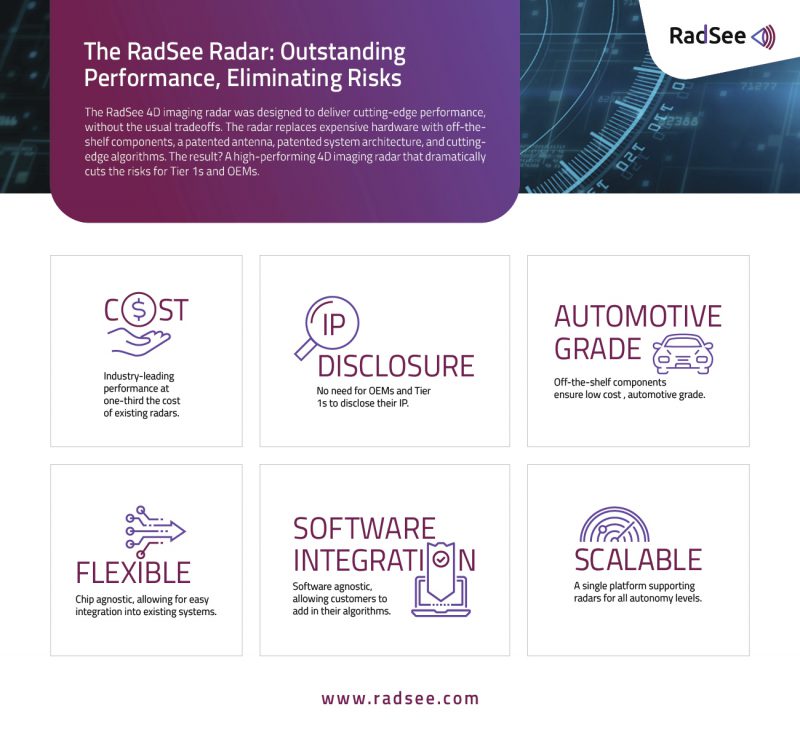
HERZLIYA, Israel, February 16, 2021 – RadSee Technologies Ltd. announced the availability of the automotive industry’s first 4D imaging radar for ADAS and autonomous vehicles able to deliver ultra-high performance and scalability to OEMs and Tier 1 suppliers at up to one-third the cost of previous solutions. By combining the company’s algorithms and patented antenna and system architecture with 77GHz commercial off-the-shelf (COTS) components, RadSee eliminates development risk as well as the usual trade-off between cost and performance.
The relevance of the company’s game-changing approach to automotive radar was emphasized last week when RADA Electronic Industries Ltd., (Nasdaq: RADA, TASE: RADA) announced its intent to make a $3M investment in RadSee. RADA is a global defense technology company focused on proprietary radar solutions.
The RadSee platform scales to accommodate different autonomy levels – standard, premium and LiDAR-like – that are easily integrated, enabling widespread adoption across the entire spectrum of current and future automotive requirements. RadSee’s technology is available for immediate integration into current ADAS design cycles as well as emerging autonomous vehicles.
Features and benefits of the RadSee 4D automotive imaging radar include:
“The automotive radar industry, poised to a market increase to above $10 billion by 2025*, is eager for an innovative solution to make 4D imaging radar happen, but still the cost matters,” asserts Cédric Malaquin, Technology & Market Analyst at Yole Développement. “An approach combining cost effective off-the-shelf automotive grade components with cutting-edge performance, is likely to be a winning solution. At Yole, we track the many alternatives, analyze their strengths and drawbacks and deliver a comprehensive and accurate vision of this industry.”
As a key safety feature, automotive cameras alone are unreliable when driving conditions are dark or glaringly bright, or when the weather is bad, and LiDAR remains prohibitively expensive. Radar, however, is proven effective under any conditions using radio-frequency transmitters and receivers to accurately determine the shape, size, and movement of all objects in view, no matter the environmental conditions.
“With constant progress in ADAS, and direct feedback from key automotive industry players, the need for affordable, high-accuracy radars has never been greater,” said RadSee Co-founder and CEO, Arnon Afgin. “Our team focused on developing a radar solution that specifically addresses cost and risk – the key obstacles to widespread adoption by OEMs and Tier 1s.”
Co-founder and CSO Dr. Dani Raphaeli added, “Industry-leading performance has historically come with a high price tag plus significant development complexities and risks. In contrast, RadSee’s radar technology eliminates the usual trade-offs between cost, risk and performance, making widespread adoption of 77GHz radars a real possibility for the first time.”
Interested OEMs and Tier-1s may contact RadSee directly for more information and design consultation.
*Source: Status of the Radar Industry: Players, Applications and Technology Trends report, Yole Développement, 2020
Dual-side cooling (DSC) shrinks package footprint by 57% compared with TOLT, packing more power into…
Supporting manufacturers with reliable defect identification and scalable quality control across production lines Leica Microsystems,…
The Magnum E2 system supports emerging DRAM and NAND interfaces while using common hardware and…
The first unmanned ground systems left the production line only 12 weeks after the two…
The available-now engineering assistant connects language models to AMD development tools, documentation and reusable FPGA…
The 0.6 × 0.3 mm capacitors occupy 64% less mounting area than Murata’s previous smallest…