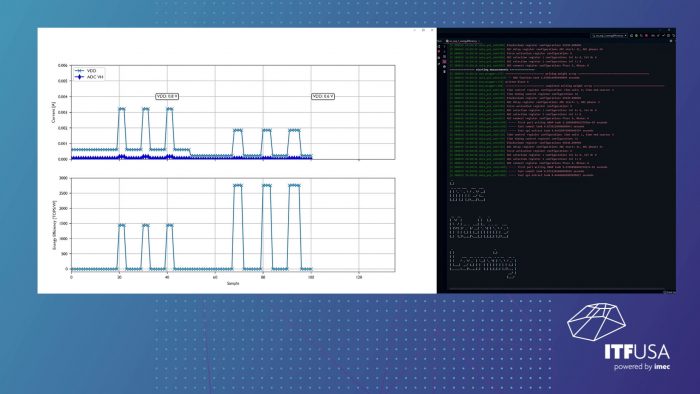
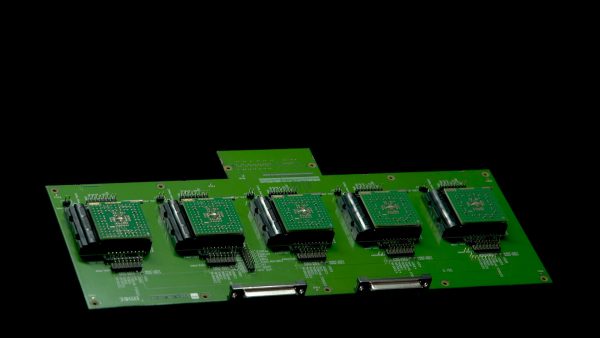
LEUVEN (Belgium), and Santa Clara, Calif., July , 2020 — Imec, a world-leading research and innovation hub in nanoelectronics and digital technologies, and GLOBALFOUNDRIES® (GF®), the world’s leading specialty foundry, today announced a hardware demonstration of a new artificial intelligence chip. Based on imec’s Analog in Memory Computing (AiMC) architecture utilizing GF’s 22FDX® solution, the new chip is optimized to perform deep neural network calculations on in-memory computing hardware in the analog domain. Achieving record-high energy efficiency up to 2,900 TOPS/W, the accelerator is a key enabler for inference-on-the-edge for low-power devices. The privacy, security and latency benefits of this new technology will have an impact on AI applications in a wide range of edge devices, from smart speakers to self-driving vehicles
Video: https://vimeo.com/436410439/732aebec23
Since the early days of the digital computer age, the processor has been separated from the memory. Operations performed using a large amount of data require a similarly large number of data elements to be retrieved from the memory storage. This limitation, known as the von Neumann bottleneck, can overshadow the actual computing time, especially in neural networks – which depend on large vector matrix multiplications. These computations are performed with the precision of a digital computer and require a significant amount of energy. However, neural networks can also achieve accurate results if the vector-matrix multiplications are performed with a lower precision on analog technology.
To address this challenge, imec and its industrial partners in imec’s industrial affiliation machine learning program, including GF, developed a new architecture which eliminates the von Neumann bottleneck by performing analog computation in SRAM cells. The resulting Analog Inference Accelerator (AnIA), built on GF’s 22FDX semiconductor platform, has exceptional energy efficiency. Characterization tests demonstrate power efficiency peaking at 2,900 tera operations per second per watt (TOPS/W). Pattern recognition in tiny sensors and low-power edge devices, which is typically powered by machine learning in data centers, can now be performed locally on this power-efficient accelerator.
“The successful tape-out of AnIA marks an important step forward toward validation of Analog in Memory Computing (AiMC),” said Diederik Verkest, program director for machine learning at imec. “The reference implementation not only shows that analog in-memory calculations are possible in practice, but also that they achieve an energy efficiency ten to hundred times better than digital accelerators. In imec’s machine learning program, we tune existing and emerging memory devices to optimize them for analog in-memory computation. These promising results encourage us to further develop this technology, with the ambition to evolve towards 10,000 TOPS/W”.
“GlobalFoundries collaborated closely with imec to implement the new AnIA chip using our low-power, high-performance 22FDX platform,” said Hiren Majmudar, vice president of product management for computing and wired infrastructure at GF. “This test chip is a critical step forward in demonstrating to the industry how 22FDX can significantly reduce the power consumption of energy-intensive AI and machine learning applications.”
Looking ahead, GF will include AiMC as a feature able to be implemented on the 22FDX platform for a differentiated solution in the AI market space. GF’s 22FDX employs 22nm FD-SOI technology to deliver outstanding performance at extremely low power, with the ability to operate at 0.5 Volt ultralow power and at 1 pico amp per micron for ultralow standby leakage. 22FDX with the new AiMC feature is in development at GF’s state-of-the-art 300mm production line at Fab 1 in Dresden, Germany.
The collaboration between Tower Semiconductor and Scintil Photonics offers a clear view into the future…
How virtual twins, accelerated computing and physics-based models are turning AI from smart software into…
For decades, cellular communication has relied on one almost unquestioned assumption: the base station is…
IBM (NYSE: IBM) today announced new results that its quantum computer can simulate real magnetic materials…
Arrow Electronics has announced the launch of a new evaluation platform, jointly designed in collaboration…
Siemens has unveiled Drivetrain Analyzer Onsite, a new on-premises analytics solution for industrial drive systems,…