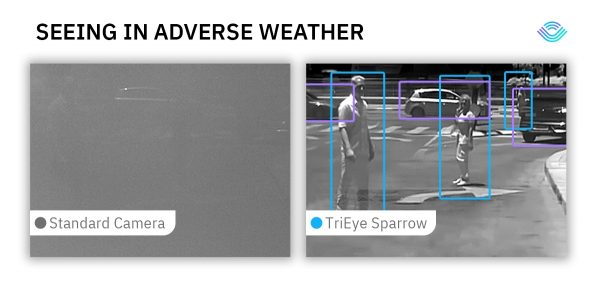
Israeli startup TriEye, a Tel-Aviv based company whose Short-Wave Infrared (SWIR) sensing technology enhances visibility in adverse weather and night time conditions, has officially revealed Sparrow – the world’s first CMOS-based SWIR camera.
Among the companies that are collaborating with TriEye and are evaluating the Sparrow is the global automotive supplier DENSO, in addition to the leading sports car manufacturer Porsche – collaboration published earlier this year.
The evaluation of Sparrow by DENSO, Porsche, and additional TriEye customers, proves the product’s ability to deliver mission-critical image data under a wide range of scenarios, made possible by leveraging the unique physical properties of the SWIR spectrum. The sensor is particularly effective in low visibility conditions such as identifying black ice, dark clothed pedestrians, and cyclists – all under low-light or other common low visibility conditions, detection scenarios that are paramount for the automotive industry.
“We are proud and delighted to announce our collaboration with DENSO which marks a meaningful step forward in delivering our mission of solving the low visibility challenge,” said Avi Bakal, TriEye’s Co-Founder and CEO, “The joint work has been greatly beneficial since day one, bringing together DENSO’s innovative approach and market experience with TriEye groundbreaking technology.“
TriEye aims to solve the low-visibility challenge on the roads by making SWIR cameras affordable and accessible for the global mass market. The release of Sparrow, the world’s-first CMOS-based SWIR camera, marks a major milestone towards that goal. The company is expected to launch the first samples of Raven, the world’s first CMOS-based SWIR HD camera, later this year.
TriEye’s SWIR camera can be integrated as a standard visible camera and can reuse existing visible image AI algorithms, which saves the effort of recollecting and annotating millions of miles. The camera will allow Advanced Driver Assistance Systems (ADAS) and Autonomous Vehicles (AV) to achieve unprecedented vision capabilities to save lives on the roads.
InGaAs-based SWIR cameras have been around for decades, serving the science, aerospace, and defense industries, but have not been used for mass-market
applications due to their high costs and large form factor. Based on a decade of nanophotonics research, TriEye enables the fabrication of a CMOS-based HD SWIR sensor at scale, which is small size and 1000x lower cost than current technology.
In addition to the evaluation by TriEye’s automotive customers, the company has already delivered samples of the Sparrow to its non-automotive customers, allowing them to take advantage of TriEye’s SWIR capabilities to see beyond the visible and solve complex industry challenges.
This achievement follows other major milestones announced by TriEye in the past year, including a $19M Series A funding round, led by Intel Capital, with the participation of Porsche Ventures and Grove Ventures, as well as a collaboration with Porsche AG.
Main Picture: Avi Bakal CEO and co-founder of TriEye. Photographer – David Garb
The collaboration between Tower Semiconductor and Scintil Photonics offers a clear view into the future…
How virtual twins, accelerated computing and physics-based models are turning AI from smart software into…
For decades, cellular communication has relied on one almost unquestioned assumption: the base station is…
IBM (NYSE: IBM) today announced new results that its quantum computer can simulate real magnetic materials…
Arrow Electronics has announced the launch of a new evaluation platform, jointly designed in collaboration…
Siemens has unveiled Drivetrain Analyzer Onsite, a new on-premises analytics solution for industrial drive systems,…