LATEST NEWS

Siemens and VDL shaping future tech for electrical charging

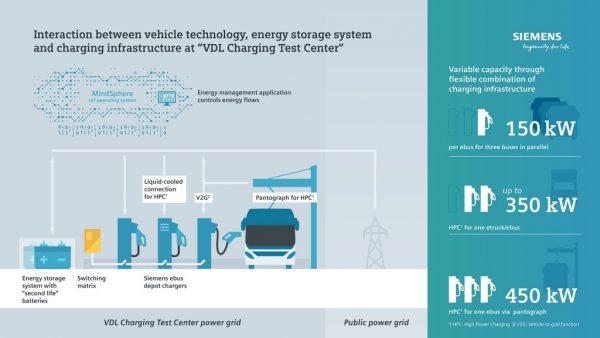
In the VDL Charging Test Center, the combination of these future-oriented technologies will now undergo testing under real-life conditions to ensure its functionality during operations. Customers of both companies are welcome to visit the validation and test center to examine the technology firsthand.
“The charging technology from Siemens allows us to test different eBus and eTruck technologies in combination with charging stations and an energy storage system,” says Menno Kleingeld, Managing Director at VDL Enabling Transport Solutions. “With the energy management application we can control the flow of energy as needed. We also use second-life batteries in the storage system, which means we can re-use our earlier eBus batteries and give them a new lease of life.”
The vehicle-to-grid function integrated in one of the charging stations allows the vehicles to be charged bidirectionally. This means they can not only draw power from the grid and the storage system, but also feed energy back into these systems. This function paves the way for future use cases such as covering peaks in power demand. This means, electric vehicles are able to communicate with the grid and provide power back in case of capacity constraints.
“We are excited to collaborate with VDL on this innovative project, which brings us a step closer to making eMobility more flexible and efficient,” said Monique Mertins, Head of Charging Infrastructure for eBus and eUtility Vehicles at Siemens Smart Infrastructure. “Three of our latest 150 kilowatt (kW) fast charging stations are being used in Valkenswaard. The charging electronics can be temporarily interconnected, making it possible to charge three vehicles in parallel with a capacity of 150 kW each, or one vehicle particularly rapidly up to 450 kW using High-Power Charging (HPC). This means power can be adjusted flexibly and the charging infrastructure optimized for depots with different requirements.”
The modular infrastructure in Valkenswaard demonstrates that charging systems can have the ability to expand over a long period of time without the need to adjust the grid capacity or connection. By coupling an energy storage system with charging stations and an energy management application the capacity could be adjusted according to current and future needs. The project provides important insights for the electrification of the transport sector and for a successful energy transition.

SIVAN

Recent Posts

NVIDIA and AWS Expand Full-Stack Partnership, Providing the Secure, High-Performance Compute Platform Vital for Future Innovation

AWS integrates NVIDIA NVLink Fusion into its custom silicon, including the next-generation Tranium4 chip, Graviton…

5 days ago

Molex Names Top 10 Connectivity and Electronics Design Predictions for 2026, Fueled by Far-Reaching Impact of Artificial Intelligences Across Major Industries

Intensifying AI demands continue to proliferate across aerospace and defense, automotive, consumer electronics, data center,…

5 days ago

Tria Technologies to bring Qualcomm DragonwingTM IQ-6 Series to market with two new compute modules

 TRIA SM2S-IQ615 and TRIA OSM-LF-IQ615 modules enable next-generation edge AI systems across a wide range…

5 days ago

At NeurIPS, NVIDIA Advances Open Model Development for Digital and Physical AI

NVIDIA releases new AI tools for speech, safety and autonomous driving — including NVIDIA DRIVE…

5 days ago

OMRON eases PCB-relay assembly and replacement with P6K surface-mountable sockets

 P6K sockets for G6K through-hole relays ensure reliability, flexibility, and repairability  OMRON Electronic Components Europe…

5 days ago

GEOX.AI and Mitsui Sumitomo Insurance Launch AI-Powered Initiative to Assess Building Risk Across Japan

GEOX.AI, a global leader in AI-driven property intelligence, announced today a strategic partnership with Mitsui…

5 days ago