The growing demand for highly complex aircraft systems is placing increased pressure on suppliers to deliver aircraft with far greater capabilities while complying with a growing demand for safety certification, as most advanced cockpits require software that is considered safety-critical. One way to address this complexity is to use more commercial-off-the-shelf (COTS) software technologies that come with certification evidence that can be included in the submission with the Federal Aviation Administration (FAA), EASA, or other safety agencies who grant the authorization to operate an aircraft. When technology suppliers create this evidence significant risk is removed from avionics companies who must minimize this risk at all levels of a new program. This becomes even more important when using multi-core processors where there is no straightforward path to certification; therefore the project risk increases exponentially.
To help avionics suppliers reduce the risk and cost of certification, Wind River today announced the certification evidence release for VxWorks® 653 Multi-core Edition on an advanced PowerPC multi-core processor, meeting the rigorous RTCA DO-178C and EUROCAE ED-12C DAL A requirements. This release adds the certification evidence package needed to comply with the FAA’s safety requirements – designs, tests, reviews, source code, build files, test results, annotated object-level code coverage, and tool qualification data for critical integrated modular avionics (IMA) systems.
Certification: Multi-core systems use case
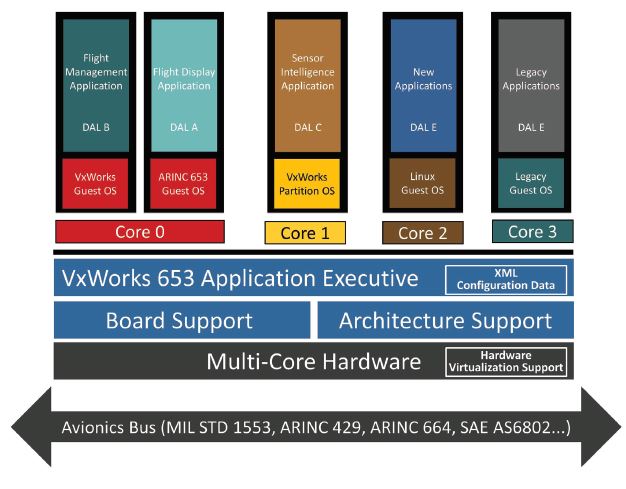
Multi-core systems bring an additional layer of complexity in terms of system integration and certification. Beyond the technical aspects related to safe partitioning, avionics suppliers must also manage the business concerns related to pulling in applications from various providers. These applications must all share the same processor, but they often times can be certified at different certification design assurance levels (DAL), according to their impact on mission safety. Another critical issue for avionics companies is shortening the development cycle and certification cost of adding features to software. For instance, if one application is updated, or another one added, this raises the question whether the whole system should go through a recertification process or if certification can be done only on the affected application.
In VxWorks® 653 Multi-core Edition these platforms can run on different partitions. They can be updated and certified separately. Using robust partitioning and a qualified XML compiler, one partition can be updated and certified without affecting the rest of the system. This is extremely valuable when deploying applications at different levels of safety criticality. Without a robust partitioning strategy all applications would have to be certified at system high – with robust partitioning each IMA application only needs to be only at its minimum DAL level. Investing in multiple recertification projects for the entire system at system high creates far higher cost and schedule risk for the avionics project.
With the release of the certification evidence for VxWorks 653 Multi-Core Edition, Wind River is providing practical evidence of its premier certification of the multi-core solution for ARINC 653 IMA systems, allowing avionics companies to lower project risks for multi-core systems certification.
Open and Secure Synopsys Autopilot Platform Accelerates Engineering Productivity, Improves Design Quality, and Achieves Faster…
Acquisition brings leading AI model research expertise to AMD, helping to shape future AI infrastructure…
Following its merger with Bank Leumi USA, the expansion of its activities with technology companies…
Infineon and Eaton are partnering to drive solid-state transformer (SST) technology The collaboration addresses demand…
The future of work belongs to people and AI agents. Island built the control plane…
Financing builds on FDA clearances, growing clinical evidence and commercial traction to advance the UltraSight…