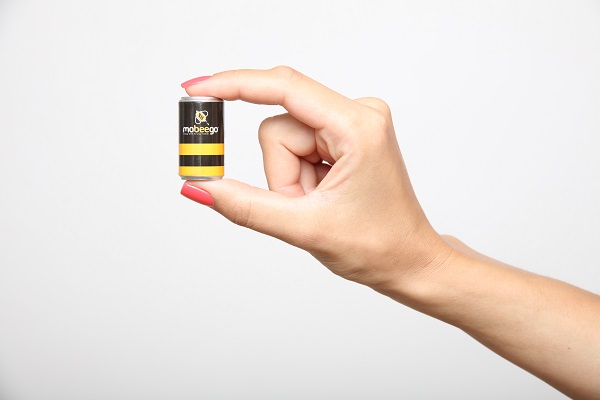
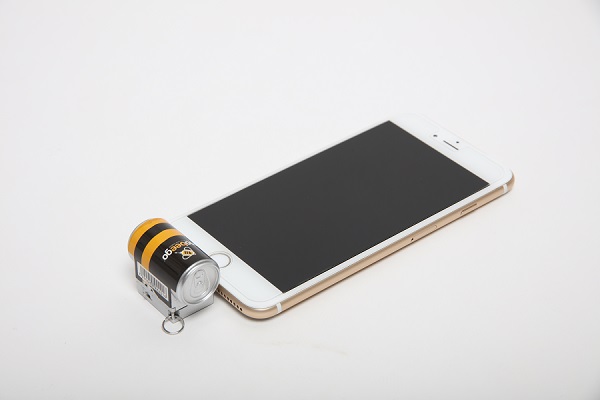
The startup mobeego is carrying out the worldwide launch of its mobeego disposable charger, which can charge a smartphone battery for up to four hours, at a price of around $2.50 per charging unit. The company describes its product as an “energy drink for the mobile phone” and the charging unit is actually designed in the shape of a tiny energy drink can.
The mobeego charger contains two simple elements. One is a miniature adapter for Google Android and Apple iOS-based phones, and the second element is the charging unit, which attaches to the adapter and is connected to the telephone, and is expected to cost around $2.50.
mobeego is already in advanced talks with potential franchisees in several countries, including the US, Germany, France, Belgium, Russia, South Africa, Chile and Israel. The company plans to initially sell several hundred thousand charging units in the coming months and grow in 2016.
The mobeego charger is compliant with the CE and FCC standards, and its battery is compliant with the UL standard.
The mobeego adapter weighs 4 grams (0.14oz) and is 2.2-cm (0.87”) long by 2.6-cm (1.02”) wide. The charging unit (“the energy drink can”) weighs 24 grams (0.85oz) and is 2.2-cm (0.87”) long by 4-cm (1.57”) wide. The outlet voltage is 5 volt, and the outlet current is 650 milliampere (mA). The products are packed for maximum efficiency to minimize storage space and transportation costs.
NVIDIA has announced strategic partnerships with photonics manufacturers Coherent and Lumentum to develop next-generation optical…
Infineon Technologies has introduced the EZ-PD™ PMG1-B2, described as the industry’s first single-port USB Type-C…
Cato Networks Unveils World’s First Auto-Adaptive Threat Prevention Engine in a SASE Platform to Stop…
SCHURTER positions Lucerne as global technology and innovation hub SCHURTER Group has outlined plans to…
Menlo Microsystems, in collaboration with Purdue University, has demonstrated a commercial-ready architecture for quantum control…
Compact board-mount contactor replacement with optimized 1500VDC/25A-make current Hoofddorp, The Netherlands, 4 March 2026 -…