The Industry’s First CXPI-Compatible Transceiver IC — Supports the next-generation vehicle communication protocol for reduced wire count and improved fuel efficiency
ROHM has recently announced the availability of a transceiver IC compatible with the new low-speed, low-cost CXPI communication protocol for use in body control applications, including steering switch, AC, and instrument panel systems.
product
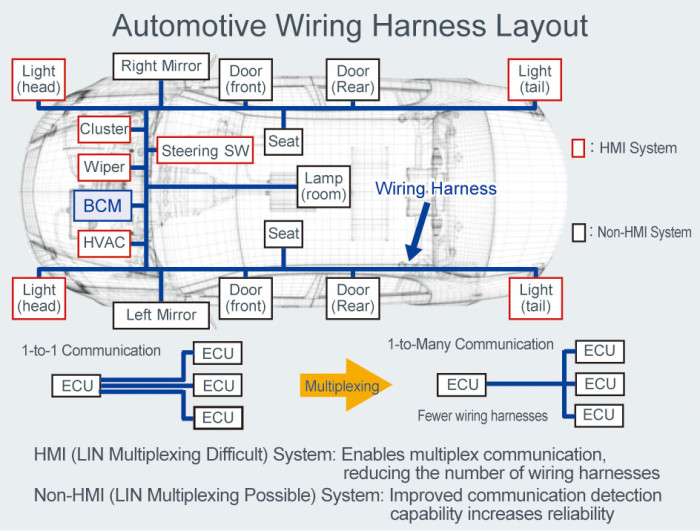
The BD41000FJ-C enables multiplexing between ECUs, contributing to decreased vehicle weight and improved fuel efficiency by reducing the number and size of wiring harnesses. In addition, low quiescent current (3uA typ.) and high ESD resistance (±8kV, IEC61000-4-2) make it possible to achieve low-power, high-reliability CXPI communication.
In recent years the continuing demand for increased fuel efficiency makes it necessary to not only minimize system power consumption through electronic control but reduce vehicle weight as well by using lighter components, including wiring harnesses.
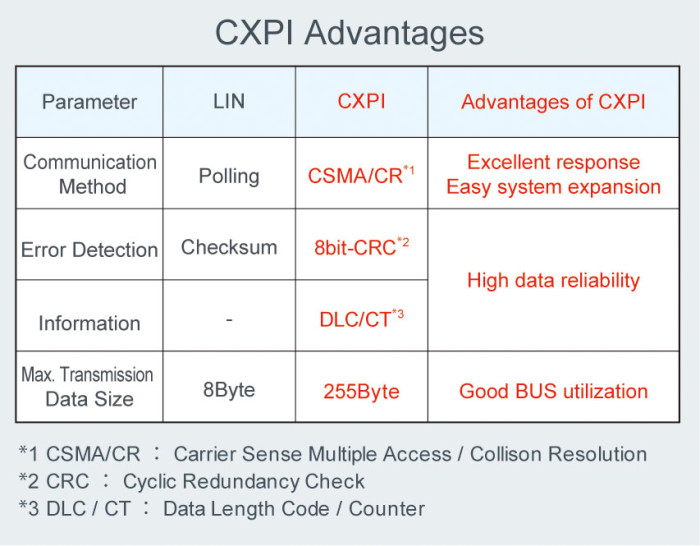
To decrease weight, many systems adopt LIN for multiplex communication. However, with LIN it is difficult to achieve sufficient reliability and communication response when multiplexing in HMI (Human Machine Interface) applications such as wipers, lights, and steering switches.
In response, JASO (Japanese Automotive Standards Organization) an automotive standardization organization established by JSAE (Society of Automotive Engineers of Japan), developed the next-generation automotive communication protocol CXPI to reduce the number and weight of wiring harnesses by making multiplexing possible even in advanced, multifunction HMI systems.
Subsequently, as a leading semiconductor manufacturer, in 2012 ROHM contributed to the standardization of CXPI while leveraging cutting-edge power BiCDMOS processes and advanced analog design technology to develop the world’s first CXPI transceiver IC.
Key Features
Although LIN is often used for body control, it is often difficult to achieve sufficient performance and reliability in HMI applications that require instantaneous response.
In contrast, the BD41000FJ-C is compliant with the CXPI standard established by JSAE, enabling highly responsive, reliable multiplex communication even in HMI systems, reducing vehicle weight and contributing to greater fuel efficiency.
Market-proven circuit technology is utilized to achieve a quiescent current of 3uA (typ.), ensuring suitability with automotive applications. As a result battery load is minimized during non-operation, contributing to greater energy savings.
ROHM leverages advanced BiCDMOS processes and proven analog design technology to provide low output noise with high ESD resistance (±8kV, IEC61000-4-2). This provides superior reliability, enabling use even under harsh environments.
Pricing: 4.20 USD/sample (excluding tax)
Availability: February 2016 (Samples), May 2016 (OEM Quantities)
Terminology
CXPI (Clock Extension Peripheral Interface)
A next-generation automotive communication standard established by JSAE, featuring superior responsiveness and reliability compared with the LIN system. CXPI makes it possible to implement multiplexing in HMI applications difficult to achieve with LIN.
JSAE (Society of Automotive Engineers of Japan), JASO (Japanese Automotive Standards Organization)
Founded in 1947, JSAE, whose aim is to ‘promote scientific culture, expand the industrial economy, and improve the quality of people’s lives by furthering the development of automobile science and technology,’ is widely recognized as the leading scientific society in Japan, with over 40,000 members.
JASO, established by JSAE, is tasked with ensuring technological progress and safety related to automobiles (including motorcycles) and improving production efficiency.
LIN (Local Interconnect Network)
An automotive communication standard advocated by automotive manufacturers in Europe that achieves multiplexing in order to reduce network costs. Primarily used for communication between ECUs in automotive body applications.
NVIDIA has announced strategic partnerships with photonics manufacturers Coherent and Lumentum to develop next-generation optical…
Infineon Technologies has introduced the EZ-PD™ PMG1-B2, described as the industry’s first single-port USB Type-C…
Cato Networks Unveils World’s First Auto-Adaptive Threat Prevention Engine in a SASE Platform to Stop…
SCHURTER positions Lucerne as global technology and innovation hub SCHURTER Group has outlined plans to…
Menlo Microsystems, in collaboration with Purdue University, has demonstrated a commercial-ready architecture for quantum control…
Compact board-mount contactor replacement with optimized 1500VDC/25A-make current Hoofddorp, The Netherlands, 4 March 2026 -…