Abstract – Laser circuits and systems come in many topological structures and present many specific implementations which stand the target scientific and engineering features. The main types of lasers are categories by the lasing medium and are classified as either laser diode (semiconductor laser), Ti: Sapphire laser, ion – channel and log wavelength laser, solid – state laser, Nd: YAG, mid – infrared Q – switched microchip laser, gas laser, dual – wavelength laser, helium – neon laser, carbon dioxide laser, metal vapor laser, rare gas ion laser, excimer laser, chemical laser, and gas dynamic carbon dioxide laser. Additionally, there are dye laser, free – electron laser (FEL), X – ray laser, quantum cascade laser, lead salt laser, antimonide laser, and femtosecond laser. Femtosecond laser micromachining system is used in ultrafast machining. Sometimes 20 – fold reduction in pulse duration relative to a picosecond system gives advantages in terms of material interaction. By using picosecond or femtosecond laser, we can get a very high peak power density. These types of lasers can be used to machine otherwise transparent materials such as silica or sapphire. Nonlinear absorption enables the light to interact with transparent materials, causing very strong, extremely localized heating and ablation. The strength of the laser ablation process results in a very low debris process. High – power (Petta watt, 1015 w) laser involves real – time controls and femtosecond precision timing systems. We can synchronize operation of lasers to specific beamline clock and get a broadband laser pulse stretcher with pulse compress. Laser diodes consist of a p-n diode with an active region where electrons and holes recombine resulting in light emission.
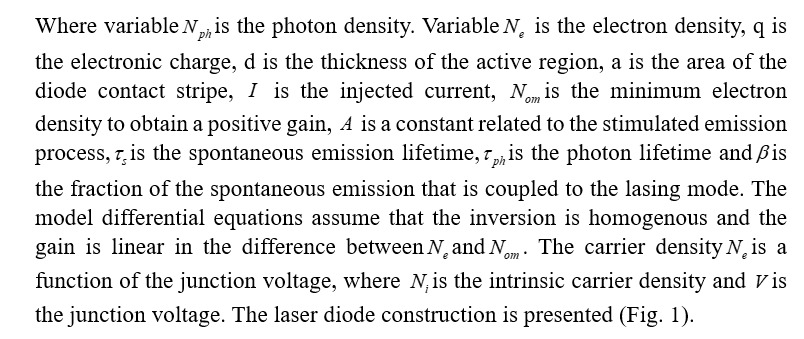
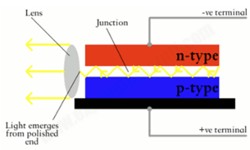
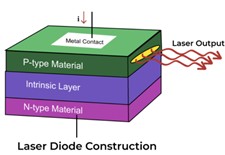
Laser diode consists of a p-n diode with an active region where electrons and holes recombine resulting in light emission. The laser diode contains an optical cavity where stimulated emission takes place. The laser cavity consists of a waveguide terminated on each end by a mirror. The laser diode complete equivalent circuit is separated into two parts. The first part represents the intrinsic electrical equivalent circuit of the laser chip. The second part is the electrical equivalent circuit of the package including the major parasitic elements. The elements of the intrinsic laser equivalent circuit are derived from the coupled rate equations which describe the interplay between the injected carrier and photon densities in the active region of the laser diode. We define the parasitic effects of the stimulated emission process as a latent period τ. The laser diode coupled single mode delayed differential rate equations are given by the following DDEs (Delay Differential Equations):
Fig. 1 Laser diode construction
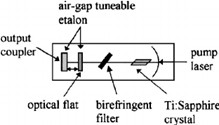
A solid-state laser is a laser that uses a gain medium that is a solid. solid-state lasers have lasing material distributed in a solid matrix such as the ruby or neodymium “YAG” lasers. Solid-state lasers use optical pumping and such pump sources are relatively cheap and can provide very high powers. It has low power efficiency, moderate lifetime, and strong thermal effects such as thermal lensing in the gain medium. Laser diodes are very often used for pumping solid-state lasers. The Neodymium doped Yttrium Aluminium Garnet-Nd:YAG laser crystal is the most popular lasing media for solid-state lasers. The gain medium in solid-state laser is a solid rather than a liquid laser. The solid-state lasers gain media can be crystals or glasses doped with rare earth or transition metal ions, or semiconductor lasers. Ion-doped solid-state lasers (Doped insulator lasers) can be made in the form of bulk lasers, fiber lasers or other types of waveguide lasers. Solid-state lasers may generate output powers between a few mill-watts and in high-power versions many kilowatts. Solid-state lasers are optically pumped with flash lamps or arc lamps. Such pump sources are good high-power supply and lead to a low power efficiency, moderate lifetime, and strong thermal effects such as thermal lensing in the gain medium. Solid-state lasers are composed of two main components: a solid host material and an active ion that is doped into the host material. The Structure diagram of solid-state laser is presented (Fig. 3).
In Gas lasers the lasing medium is made-up of one or a mixture of gases or vapors. Gas lasers can be classified in terms of the type of transitions that lead to their operation: atomic or molecular. The most common of all gas lasers is the helium-neon (He-Ne) laser. The presence of two atomic species (helium and neon) in this gas laser might suggest that the medium is made of molecules, but these two species of atoms do not form a stable molecule. A Lasing from molecular nitrogen is used in many scientific and industrial applications. The discharge pumped nitrogen laser, operating in a broad range of gas pressures, from several mill bars to the atmospheric pressure, and repetition rates from several hertz to several kilo hertz. It is remotely initiated lasing from molecular gases by femtosecond filaments. The construction of Gas laser is presented (Fig. 4).
Reference:
Aluf, Advance Elements of Laser Circuits and Systems: Nonlinearity Application in Engineering, Springer, 2021, ISBN: 978-3-030-64102-3.
The Bundeswehr acquires a fourth Automated Driverless Testing Solution from AB Dynamics The solution removes…
Munich, Germany – 17 March 2026 – Infineon Technologies AG (FSE: IFX / OTCQX: IFNNY)…
Menlo Microsystems and Rosenberger have announced a strategic partnership to develop a multichannel ultra-low power…
Infineon Technologies continues to strengthen its position as the global leader in the microcontroller (MCU)…
Tesla is reportedly exploring plans to expand its semiconductor capabilities as part of a broader…
Identity fraud has outpaced the tools businesses once relied on to fight it, so being…