Contributing to reducing power supply circuit design resources by providing stable operation with fewer external components
ROHM established QuiCur™, a new power supply technology that improves the load transient response characteristics (response performance involving response speed, and voltage stability of subsequent stage) of DC/DC converter ICs (Switching regulators) and LDOs (Linear regulators).
In recent years, the continuing electrification of applications in all areas has increased the number of electronic components along with design resources required. As such there is a rising demand to reduce the number of capacitors used for a variety of purposes, such as stabilizing electronic circuits. What’s more, to reduce the design load for power supply circuits when changing specifications, high quality power supply ICs that deliver excellent response performance and the capability to provide stable operation are required.
Generally, power Supply IC constantly monitors the output voltage to ensure stable power supply functionality and includes a feedback circuit that fine-tunes the output voltage by comparing with an internal reference voltage. Providing faster response makes it possible to reverse changes in the output voltage caused by fluctuations in input voltage and/or load current in a shorter time. On the other hand, shortening the response time too much can cause the circuit operation to become unstable and the output voltage to oscillate, and as the response speed is also affected by output capacitance, until now it has been difficult to achieve the desired response performance.
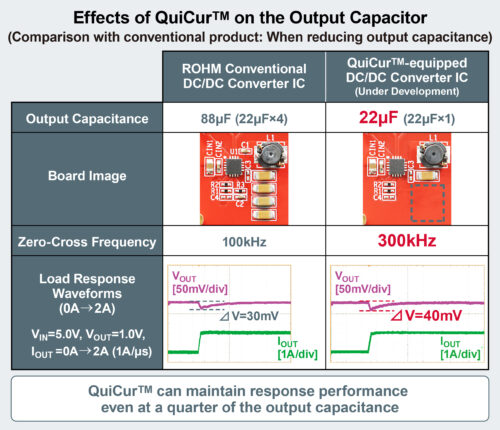
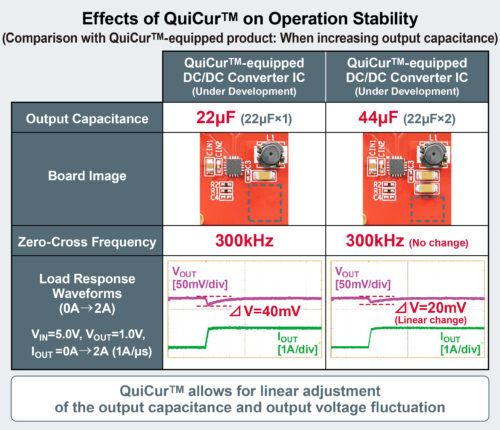
Incorporating the newly developed high-speed load response technology QuiCur™ in power supply ICs makes it possible to achieve the ideal performance without causing instability in feedback circuits. Not only can the number of external components and mounting area be reduced by minimizing the capacitance of the output capacitor required by the power supply IC, but linear adjustment of the capacitance and output voltage fluctuations (negative constant proportional relationship) is enabled, ensuring stable operation even when the capacitance increases due to specification changes. This contributes to a significant reduction in power supply circuit design resources by providing stable operation with fewer external components. (fig. 1+2)
ROHM is currently working to commercialize QuiCur™-equipped power supply ICs, with plans to ship samples of DC/DC converter ICs in April and LDOs in July of this year.
QuiCur™ Technology’s detail
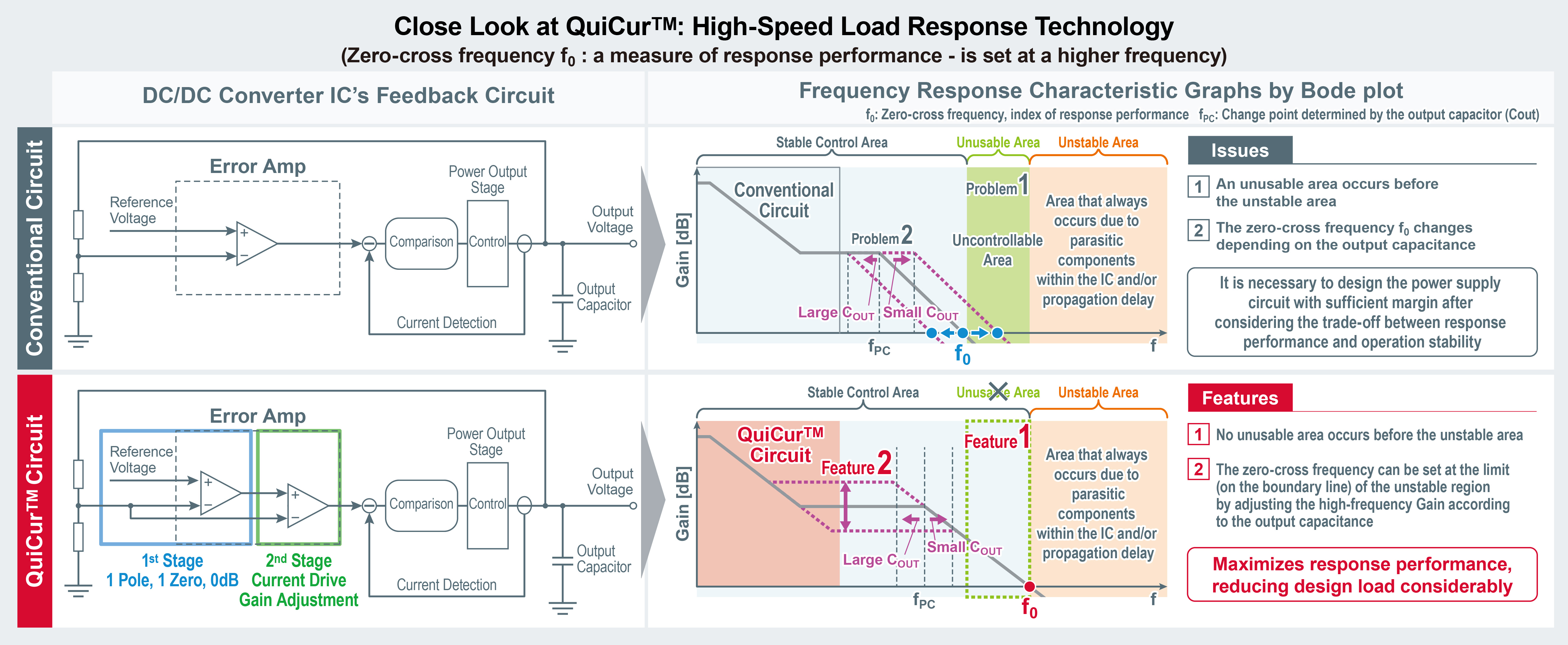
QuiCur™ solves the two problems of conventional power supply IC feedback circuits when pursuing maximum response performance, namely, (1) the unusable region generated in the frequency range lower than the unstable area, and (2) variations in the zero-cross frequency (f0) due to the output capacitance, by fully dividing the roles of signal processing for response speed (control system) and voltage stability (compensation system). The first problem was solved by utilizing a dedicated error amp that does not generate an unusable area in the feedback circuit. And for the second problem, we adopted a dedicated second-stage error amp and introduced technology that allows the amplification factor (gain) to be adjusted by current drive. Although the zero-cross frequency may vary depending on the connected output capacitance, by adjusting the amplification factor, the zero-cross frequency can always be set at the limit (on the boundary line) between the unstable and stable control regions. This system, in which the roles of the two error amps are shared, is widely applicable to power supply ICs such as DC/DC converter ICs and LDOs that incorporate feedback circuits. (Fig. 3)
Combining with Nano Cap™ Ultra-Stable Control Technology
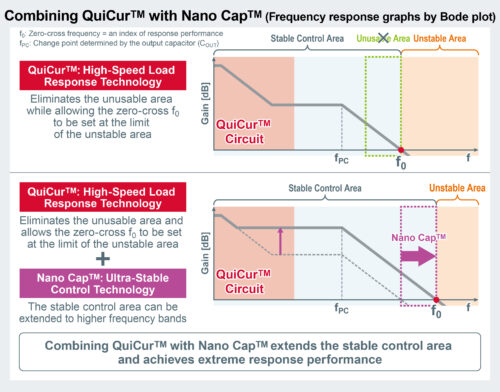
Nano Cap™ provides stable control of the linear regulator output by improving response in analog circuits while minimizing parasitic factors related to wiring and amplifiers. This allows the output capacitance to be reduced to less than 1/10th that of conventional solutions, eliminating the need for a capacitor at the output of the linear regulator and ensuring stable operation with just a 100nF capacitor at the MCU side.
Although QuiCur™ alone can reduce the output capacitance to the order of µF, combining with Nano Cap™ brings this down to the order of nF. (Fig. 4)
Click on the URL below for more information on Nano Cap™.
https://www.rohm.com/support/nano
Abstract – The radio-frequency (RF) detection coil is a transducer device that excites the nuclear…
Secure Development Processes Advance CRA Readiness and Increase Customer Cybersecurity Assurance CHANDLER, Ariz., April 2,…
There is a lot of "SaaS is dead" or "AI is coming for your job"…
Tessenderlo-Ham, Belgium, 31 March 2026 – Melexis announces the MLX80339, a code-free three-phase fan driver…
Voltify, the startup pioneering a new approach to rail electrification, today announced it has raised…
Siemens has signed a letter of intent with the European Space Agency to join its…