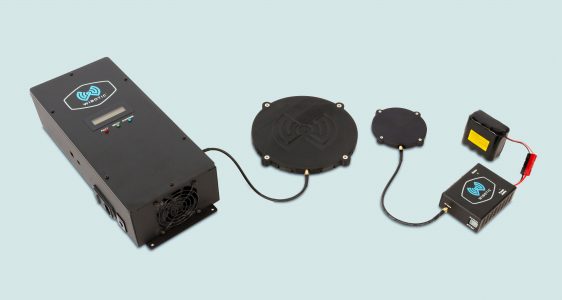
LONDON, 4th June 2020, Vicor today announce their high-efficiency power module neutralizes thermal management constraints, enabling innovative adaptive-matching transmitter for any battery, any robot, and any station.
As robotic fleets reshape logistic, delivery and inspection industries, the demand for more efficient and flexible charging solutions is increasing while the feasibility for these fleets to be managed manually and recharged ad hoc by a 24/7 rotation of personnel is decreasing. The next step is toward enhanced autonomy, whereby normal operations can be sustained without human intervention, which is where WiBotic comes in.
Driving the next generation of robotic autonomy
WiBotic, located in Seattle, WA, provides wireless charging and power optimization solutions that are integral to charging the rapidly growing ecosystem of aerial, mobile, marine and industrial robots. A range of solutions enable robots and unmanned vehicles (UVs) to be recharged through wireless charging stations, eliminating the need for human operators to physically connect the robots to chargers. In addition, wireless charging technology reduces wear and tear on physical connection points, trip hazards from power cords and floor-mounted charging stations, and the space requirement for dedicated charging rooms.
WiBotic wireless charging solutions are designed to facilitate “many-to-many” operation, whereby multiple robots (including from different manufacturers) can charge from the same transmitter at different times. Alternatively, an entire fleet of robots can move between a network of transmitters in different locations within a warehouse. In short, any robot can charge from any station, even if the robots have different battery chemistries, voltages and charging current.
Vicor Zero-Voltage Switching (ZVS) regulator powers wireless charging innovation
The Vicor 48V VI Chip® PRM Regulator is a 400W high-efficiency converter that operates from a 36 – 75V input to generate a regulated output. The device powers the adaptive matching transmitter onboard the WiBotic TR-110 wireless charging station, which feeds power wirelessly to the robot’s or UV’s onboard receiver. The PRM accepts 48V from an AC-DC power supply and the output voltage is adaptively controlled and trimmed from approximately 20 – 55V.
The Vicor PRM enables consistent, high-efficiency conversion across the full range of impedances, flexibly supporting ‘full charge’ and ‘trickle charge’ modes with no significant drop-off in efficiency at lower power levels – a critical performance benchmark that competing power components failed to achieve. This high-efficiency conversion capability yielded a tightly consistent, maximum device temperature of 40 – 45°C, helping to neutralize thermal management constraints across the full power range.
WiBotic delivers a dynamic charging solution that enables the next generation of autonomy. Freed from the confines of manually-managed charging processes, these devices can achieve new levels of functionality and productivity – with no power constraints to hold them back.
• Charles H. Bennett helped pioneer the foundations of quantum information science alongside co-laureate Gilles…
Delta Reaches New Milestone in Electrified Intralogistics Infrastructure Delta, a global leader in power and…
First-of-its-kind framework enables seamless integration of quantum computers with advanced accelerators to support AI-native and…
The Bundeswehr acquires a fourth Automated Driverless Testing Solution from AB Dynamics The solution removes…
Munich, Germany – 17 March 2026 – Infineon Technologies AG (FSE: IFX / OTCQX: IFNNY)…
Menlo Microsystems and Rosenberger have announced a strategic partnership to develop a multichannel ultra-low power…