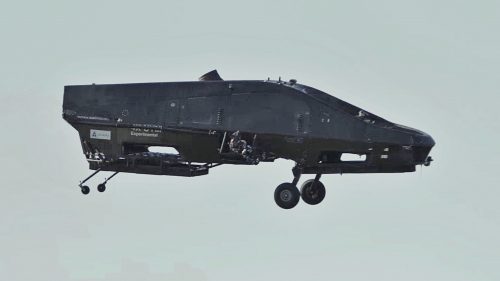
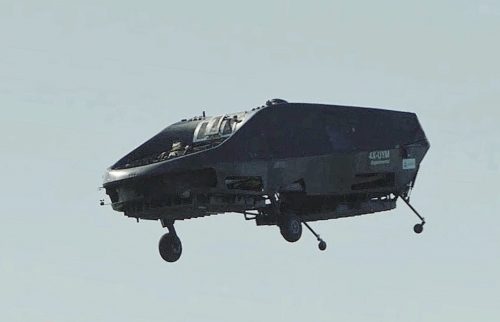
TEL AVIV, Israel, Jan. 22, 2020 – Boeing [NYSE: BA] has signed an agreement with Israel-based Tactical Robotics to explore development of a ducted fan propulsion technology with potential uses for piloted and autonomous light aircraft.
Through a joint working group, the two companies will determine what opportunities may exist in developing, producing and marketing FancraftTM –based vertical takeoff and landing (VTOL) products including Tactical Robotics’ own Cormorant autonomous vehicle. Due to its compact, Humvee-sized footprint, Cormorant can conduct emergency response missions such as delivering food, water and supplies during natural disasters or in combat environments. It can also carry up to four patients for medical evacuations.
“The relationship between Boeing and Israel goes back about 70 years, and during that period Boeing has a long history of working in partnership with Israel’s technical and industrial sectors,” said Dennis D. Swanson, vice president, International Sales, Boeing Global Sales and Marketing. “This MoU with Tactical Robotics builds on Boeing’s commitment to developing and investing in innovative technologies that lead to safe, reliable aircraft around the world.”
Rafi Yoeli, CEO of Tactical Robotics’ parent company Urban Aeronautics said, “Cormorant represents the first in a family of vertical takeoff and landing aircraft that can fly and land where no other aircraft can. We can think of no better partner than Boeing to help us develop this product and utilize the FancraftTM technology to its full potential.”
Aviation ducted fan technology uses a fan mounted in a cylindrical duct to produce thrust. This arrangement can efficiently enhance airflow velocity and pressure when compared to an open rotor. There are also notional safety advantages to the technology when compared to unshielded blades on traditional rotorcraft. FancraftTM technology improves stability, payload, speed and endurance when compared to conventional ducted fan configurations.
For more information on Defense, Space & Security, visit www.boeing.com. Follow us on Twitter: @BoeingDefense and @BoeingSpace
The collaboration between Tower Semiconductor and Scintil Photonics offers a clear view into the future…
How virtual twins, accelerated computing and physics-based models are turning AI from smart software into…
For decades, cellular communication has relied on one almost unquestioned assumption: the base station is…
IBM (NYSE: IBM) today announced new results that its quantum computer can simulate real magnetic materials…
Arrow Electronics has announced the launch of a new evaluation platform, jointly designed in collaboration…
Siemens has unveiled Drivetrain Analyzer Onsite, a new on-premises analytics solution for industrial drive systems,…