LATEST NEWS

Siemens and VDL shaping future tech for electrical charging

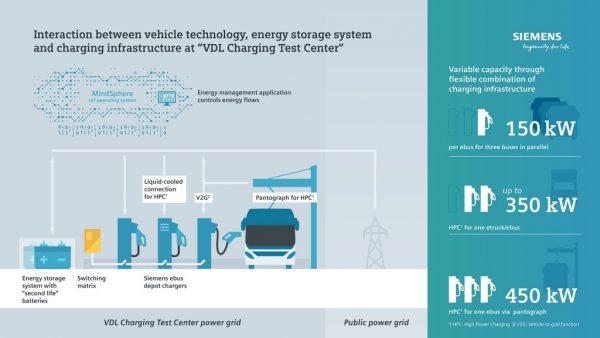
In the VDL Charging Test Center, the combination of these future-oriented technologies will now undergo testing under real-life conditions to ensure its functionality during operations. Customers of both companies are welcome to visit the validation and test center to examine the technology firsthand.
“The charging technology from Siemens allows us to test different eBus and eTruck technologies in combination with charging stations and an energy storage system,” says Menno Kleingeld, Managing Director at VDL Enabling Transport Solutions. “With the energy management application we can control the flow of energy as needed. We also use second-life batteries in the storage system, which means we can re-use our earlier eBus batteries and give them a new lease of life.”
The vehicle-to-grid function integrated in one of the charging stations allows the vehicles to be charged bidirectionally. This means they can not only draw power from the grid and the storage system, but also feed energy back into these systems. This function paves the way for future use cases such as covering peaks in power demand. This means, electric vehicles are able to communicate with the grid and provide power back in case of capacity constraints.
“We are excited to collaborate with VDL on this innovative project, which brings us a step closer to making eMobility more flexible and efficient,” said Monique Mertins, Head of Charging Infrastructure for eBus and eUtility Vehicles at Siemens Smart Infrastructure. “Three of our latest 150 kilowatt (kW) fast charging stations are being used in Valkenswaard. The charging electronics can be temporarily interconnected, making it possible to charge three vehicles in parallel with a capacity of 150 kW each, or one vehicle particularly rapidly up to 450 kW using High-Power Charging (HPC). This means power can be adjusted flexibly and the charging infrastructure optimized for depots with different requirements.”
The modular infrastructure in Valkenswaard demonstrates that charging systems can have the ability to expand over a long period of time without the need to adjust the grid capacity or connection. By coupling an energy storage system with charging stations and an energy management application the capacity could be adjusted according to current and future needs. The project provides important insights for the electrification of the transport sector and for a successful energy transition.

SIVAN

Recent Posts

Analog Devices to Acquire Alif Semiconductor for $1.35 Billion, Expanding Its Edge AI Platform

The planned acquisition will combine Analog Devices’ sensing, signal-processing, power and connectivity technologies with Alif’s…

22 hours ago

Kyocera and Tohoku University Integrate Optical Isolator Directly on Silicon Photonics

A locally applied laser-annealing process enabled the researchers to crystallise magneto-optical garnet without exposing the…

22 hours ago

NVIDIA and Palantir Deploy AI Stack to Manage NVIDIA’s Supply Chain

The system combines NVIDIA Nemotron open models with Palantir Foundry, AIP and Ontology. Its first…

4 days ago

Infineon extends collaboration with SolarEdge to enable solid-state protection for 800 VDC AI data centers

Companies extend collaboration into solid-state circuit breaker (SSCB) technology in line with leading industry framework…

5 days ago

Toyota and Rivian Adopt Stratasys’ New F870™ to Accelerate Factory-Floor Manufacturing Applications at Scale

New industrial FDM® platform expands Stratasys' production-grade portfolio with the longest heated build capacity in…

5 days ago

Imec advances scalable superconducting technology with world-first NbTiN circuits and 30nm interconnects

New superconducting digital program brings together foundries, system companies and hyperscalers around industry needs in…
6 days ago