SEO, Internet marketing e-commerce, online banking payment
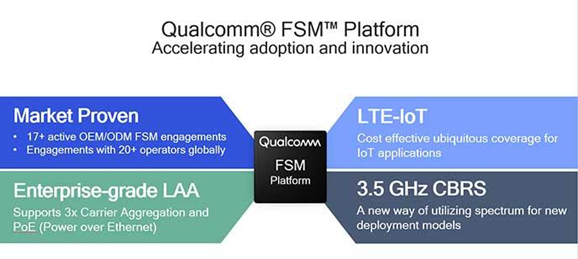
At MWC in Barcelona, Qualcomm Technologies introduced and demonstrated new LTE-IoT features on the Qualcomm FSM Small Cell platform. The Qualcomm booth also highlighted Small Cell momentum and technology innovation with a well-stocked product showcase, including MNO-branded products from the U.S., Europe and Asia. The showcase illustrated the strong growth in 4G LTE Small Cell deployment and underscores strong industry support for the technology innovations in our FSM platform.
Small Cells for the Internet of Things
According to Machina Research, May 2017, there will be more than 5 billion IoT connections by 2025. There seems to be little question around “if” wireless IoT technologies will transform many industries and experiences. And the “when” and “how” are quickly gaining clarity as LTE-IoT gains commercial momentum.
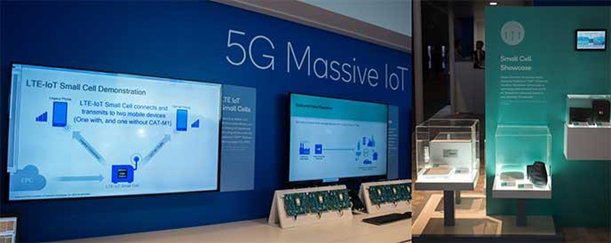
Qualcomm Small Cell team highlighted new LTE-IoT support on the FSM platform via a demonstration of eMTC (or CAT-M1) at MWC. The demonstration was designed to show the reliability of eMTC for IoT applications, compared to legacy cellular technology. While the actual demonstration included much more detail and real-time comparisons, the following gives a high-level graphical representation of what was shown.
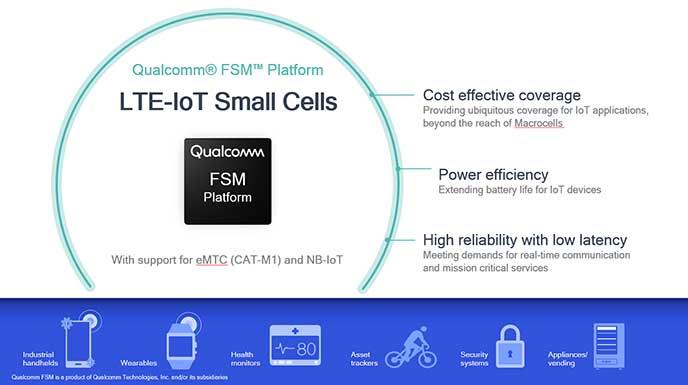
Qualcomm expect the marriage of LTE-IoT technologies (e.g., eMTC and NB-IoT) and Small Cells to play a critical role to cost effectively achieve thorough coverage and capacity for a wide variety of IoT applications, spanning residential, urban, industrial and enterprise applications, including applications the industry has not yet even thought of. While macrocells have, and continue to be, an important part of cellular networks, they will be challenged to deliver robust coverage deep indoors and in rural areas, high capacity for an unprecedented number of devices, and cost-efficiency for IoT applications to reach their full potential. For example, “outdoor-in” LTE coverage from macrocells may not reach basements where many utility meters are located.
Qualcomm FSM Product Showcase highlights growing Small Cell momentum
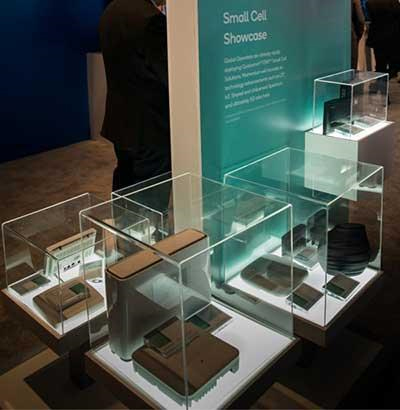
Small Cells were well represented at MWC 2018. Leading up to the show, Qualcomm worked with several of our Small Cell customers to compile a product showcase highlighting global MNO deployments and the latest technology innovations, all including Qualcomm FSM. Among many others, this showcase included the Sprint Magic Box (developed by Airspan) that was selected as the winner of “Best Mobile Technology Breakthrough” at GLOMO 2018 Awards, as well as the new Samsung Small Cell portfolio announced at MWC Americas a few months prior.
Candela’s largest funding round to date, with the World Bank’s IFC arm joining existing investors,…
• Charles H. Bennett helped pioneer the foundations of quantum information science alongside co-laureate Gilles…
Delta Reaches New Milestone in Electrified Intralogistics Infrastructure Delta, a global leader in power and…
First-of-its-kind framework enables seamless integration of quantum computers with advanced accelerators to support AI-native and…
The Bundeswehr acquires a fourth Automated Driverless Testing Solution from AB Dynamics The solution removes…
Munich, Germany – 17 March 2026 – Infineon Technologies AG (FSE: IFX / OTCQX: IFNNY)…