Silhouette of wind turbine in sunset sky
The world’s data centers consumed 416.2 Terawatt hours of electricity last year. If the estimates are accurate, over the next decade the world’s data centers will consume roughly three times the amount of electricity they do today. From an environmental perspective, that means that data centers are using 3 percent of global energy usage and are responsible for 2 percent of greenhouse gases.
So surely, the industry has a responsibility to reduce our combined carbon footprint and get energy usage down? Many data centers are committed to reducing their energy footprint and make the data center as energy efficient as possible, balancing costs as much as environmental concerns. Our partner Webaxys is a great example of a data center that has a philosophy towards reaching a zero-carbon footprint by reusing old EV batteries. Another good example of recent developments is reuse of data center waste heat; a practice seen more and more, especially in the Nordics.
As an industry, we’re helped by the fact energy providers are moving towards renewable energy. Statistics show that in 2017, 24 percent of global electricity is produced by renewables, such as solar, wind and hydro-power.
But there’s a crucial element to this conversation that’s often overlooked.
Renewable energy is volatile.
That’s not to say it’s going to blow up, but as the energy market moves from fuel-based towards renewable energy, production itself has the potential to become more volatile and harder to both predict and balance electrical supply. Also the amount of inertia, the natural frequency stabilisation mechanism of the grid, is decreasing and therefore resulting greater and faster frequency transients, especially during major faults. The supply of electricity can fluctuate and that instability is no good for data centers, which rely on clean and steady energy supply. With the rise of renewables and rising demand for electricity, it’s more likely that we’ll see fluctuating power quality in the grid.
That means data centers can play a role in helping energy providers maintain power quality by balancing power generation and consumption. Eaton has just launched a concept – the first of its kind in the data center industry – that lets organisations immediately respond to grid-level power demands to keep frequencies within allowed boundaries, thereby avoiding grid-wide power outages. To put it briefly, data centers can be compensated either for not drawing power, or for offering capacity back to the grid.
Eaton’s UPS-as-a-Reserve (UPSaaR) is the first data center solution that lets organisations earn from their UPS investment. The concept puts data centers in control of their energy, choosing how much capacity to offer, when, and at what price. Typical returns up to €50,000 per MW of power allocated to grid support per year.
We like to think of it as seeing money lying on the floor of the data center and just picking it up.
So how does it work?
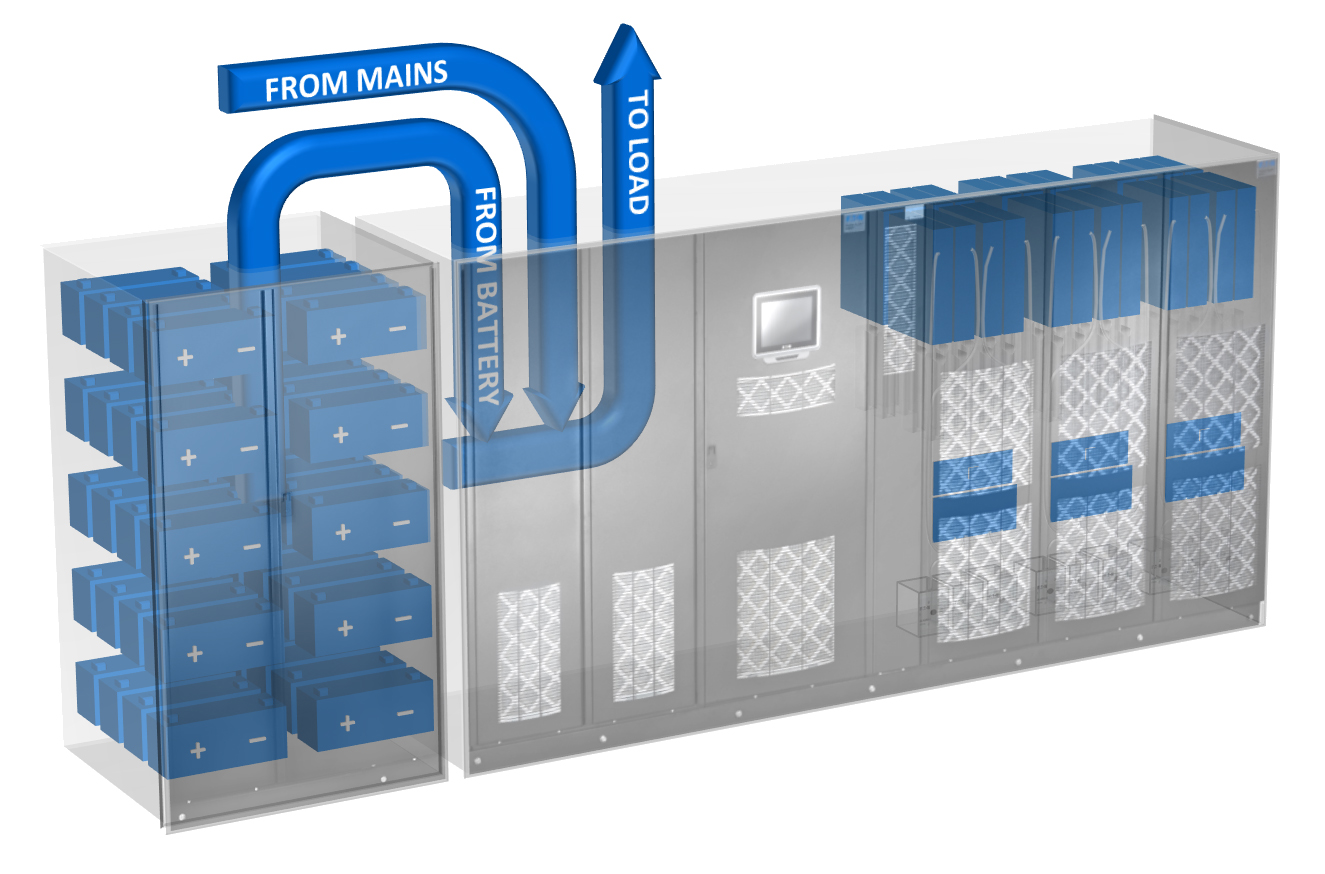
The service enables data center operators to put the UPS to work as part of a virtual power plant that enables them to take part in the high-value FCR and demand-side market. The UPS can be used to support the grid by replacing demand with power taken from batteries. The discharge power is seamlessly regulated in parallel with the UPS rectifier to provide an exact response, independent of load level. Data center operators can then support the grid in frequency regulation, generating additional revenue to offset the total cost of ownership of the UPS or as part of making the data center more competitive on price.
Eaton developed the service in close collaboration with Fortum, a leading energy provider in the Nordic and Baltic countries. During extensive trials, we’ve demonstrated that UPS systems and batteries can be safely and effectively used to perform demand-response operations, without any risks to the UPS’s primary function.
Candela’s largest funding round to date, with the World Bank’s IFC arm joining existing investors,…
• Charles H. Bennett helped pioneer the foundations of quantum information science alongside co-laureate Gilles…
Delta Reaches New Milestone in Electrified Intralogistics Infrastructure Delta, a global leader in power and…
First-of-its-kind framework enables seamless integration of quantum computers with advanced accelerators to support AI-native and…
The Bundeswehr acquires a fourth Automated Driverless Testing Solution from AB Dynamics The solution removes…
Munich, Germany – 17 March 2026 – Infineon Technologies AG (FSE: IFX / OTCQX: IFNNY)…