IC Insights’ 20th anniversary, 2017 edition of The McClean Report shows that since 2010, worldwide economic growth has been the primary influencer of IC industry growth. In this “global economy-driven” IC industry, factors such as interest rates, oil prices, and fiscal stimulus are the primary drivers of IC market growth. This is much different than prior to 2010, when capital spending, IC industry capacity, and IC pricing characteristics drove IC industry cycles.
Figure 1 plots the actual annual growth rates for worldwide GDP and the IC market from 1992 and includes IC Insights’ 2017 forecast. As shown, both of these categories displayed extremely volatile behavior from 1992 through 2010 before registering much more subdued growth rates from 2011 through 2016. Moreover, IC Insights forecasts similar restrained annual growth rates for worldwide GDP and the IC market through 2021.
Some observations regarding worldwide economic growth (GDP) include the following.
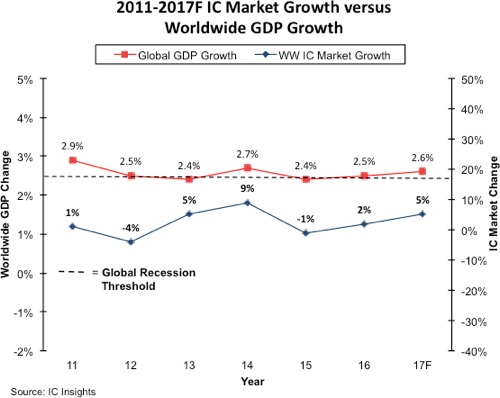
Figure 2 compares the actual annual growth rates of worldwide GDP and the worldwide IC market from 2011 through IC Insights’ 2017 forecast. It is worth mentioning that the same scale used in Figure 1 for both worldwide GDP growth (-2% to 5%) and IC market growth (-40% to 50%) was used for this chart. It is clear when looking at this specific timeperiod and using the historical growth rate scale end points, that IC market and worldwide GDP growth volatility from 2011 through 2017 is expected to be much more tame than in the past.
Worldwide GDP growth rates are expected to range from 2.5% to 3.0% from 2016 through 2021. IC Insights’ expects the IC market to mirror the narrow range of worldwide GDP growth with forecasted growth rates ranging from a low of 2% to a high of 7% through 2021.
Given the tight correlation between annual worldwide GDP growth rates and IC market growth rates, IC Insights believes that a significant and noticeable IC market cycle will not occur through 2021 unless there is a significant departure from trend, up or down, for worldwide GDP growth (e.g., <2% growth on the low side and >3.0% growth on the high side).
Report Details: The 20th Anniversary 2017 McClean Report
Top Image: Figure 1
Dual-side cooling (DSC) shrinks package footprint by 57% compared with TOLT, packing more power into…
Supporting manufacturers with reliable defect identification and scalable quality control across production lines Leica Microsystems,…
The Magnum E2 system supports emerging DRAM and NAND interfaces while using common hardware and…
The first unmanned ground systems left the production line only 12 weeks after the two…
The available-now engineering assistant connects language models to AMD development tools, documentation and reusable FPGA…
The 0.6 × 0.3 mm capacitors occupy 64% less mounting area than Murata’s previous smallest…