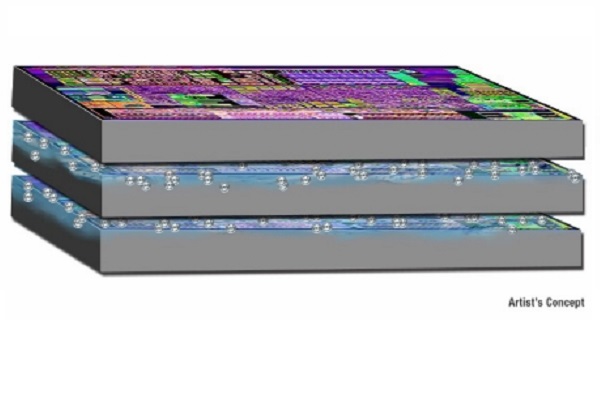
Thousands of electrical components make up today’s most sophisticated systems – and without innovative cooling techniques, those systems get hot. Lockheed Martin is working with the Defense Advanced Research Projects Agency (DARPA) Microsystems Technology Office (MTO) on its ICECool-Applications research program that could ultimately lead to a lighter, faster and cheaper way to cool high-powered microchips – by cooling the chips with microscopic drops of water.
This technology has applications in electronic warfare, radars, high-performance computers and data servers.
A core team of Lockheed Martin engineers is working on a solution to meet the goal of DARPA’s Inter/Intra Chip Enhanced Cooling (ICECool) program: to enhance the performance of RF MMIC power amplifiers and embedded high performance computing systems through chip-level heat removal techniques. Lockheed Martin experimentally demonstrated the effectiveness of its microfluidic cooling approach which resulted in a four-times reduction in thermal resistance and a corresponding six-times increase in RF output power when compared to conventional cooling techniques.
“Right now, we’re limited in the power we can put into microchips,” says John Ditri, the Principal Investigator on Lockheed Martin’s ICECool effort. “One of the biggest challenges is managing the heat. If you can manage the heat, you can use fewer chips and that means using less material, which results in cost savings as well as reduced system size and weight. If you manage the heat and use the same number of chips, you’ll get even greater performance in your system.”
Phase I of the ICECool program verified the effectiveness of Lockheed’s embedded microfluidic cooling approach by demonstrating a four-times reduction in thermal resistance while cooling a thermal demonstration die dissipating 1 kW/cm2 die-level heat flux with multiple local 30 kW/cm2 hot spots. This is about four to five times more heat per unit area than most current chips dissipate, paving the way for future chip advancements.
In Phase II of the program, the team has moved on to cooling high power RF amplifiers to validate the electrical performance improvements enabled by improved thermal management. Utilizing its ICECool technology, the team has been able to demonstrate greater than six times increase in RF output power from a given amplifier, while still running cooler than its conventionally cooled counterpart.
In its ongoing effort to move the technology out of the laboratory and into the field, Lockheed Martin is developing a fully functional, microfluidically cooled, transmit antenna prototype to increase the technology readiness level (TRL) of this technology. This will lay the foundation for possible insertions into future electronics systems.
Lockheed Martin is working with Qorvo to integrate its thermal solution with Qorvo’s high performance GaN process; a relationship that will help unleash the full potential of GaN semiconductors by removing current thermal barriers. The Lockheed Martin approach is also applicable to other current and future die technologies, such as existing Gallium Arsenide (GaAs) and future GaN on Diamond when it becomes available.
Lockheed Martin’s ICECool embedded thermal management approach removes thermal barriers to harness GaN’s full RF power handling capability. In addition to revolutionizing the way GaN amplifiers are implemented, this technology will benefit any high heat flux Integrated circuit application, including signal processing and high performance computing.
Candela’s largest funding round to date, with the World Bank’s IFC arm joining existing investors,…
• Charles H. Bennett helped pioneer the foundations of quantum information science alongside co-laureate Gilles…
Delta Reaches New Milestone in Electrified Intralogistics Infrastructure Delta, a global leader in power and…
First-of-its-kind framework enables seamless integration of quantum computers with advanced accelerators to support AI-native and…
The Bundeswehr acquires a fourth Automated Driverless Testing Solution from AB Dynamics The solution removes…
Munich, Germany – 17 March 2026 – Infineon Technologies AG (FSE: IFX / OTCQX: IFNNY)…