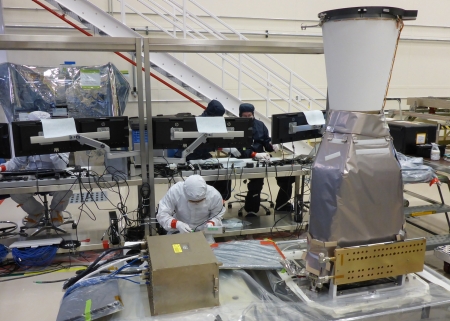
The second Geostationary Lightning Mapper undergoes final testing in Lockheed Martin’s Denver location, where technicians will integrate it with the GOES-S weather satellite. This GLM was delivered after a build and test program at the Advanced Technology Center in Palo Alto, California, where the team completed this second instrument significantly faster than the first build.
PALO ALTO, California, Jan.a, 2016 – Lockheed Martin (NYSE: LMT) delivered the second Geostationary Lightning Mapper (GLM) instrument that will provide earlier alerts of severe storms and contribute to more accurate tornado warnings. The sensor will fly on the second next-generation Geostationary Operational Environmental Satellite, known as GOES-S, for the National Oceanic and Atmospheric Administration (NOAA).
The Lockheed Martin team successfully completed assembly, integration, test and delivery of the second GLM instrument only 13 months after the first delivery.
“We reduced the build and test time of this complex instrument by 40 percent compared to the first unit,” said Jeff Vanden Beukel, Lockheed Martin GLM program director. “Now that development is complete, we are able to reduce delivery time so the GOES program can serve our nation with more accurate weather information.”
The second Geostationary Lightning Mapper undergoes final testing in Lockheed Martin’s Denver location, where technicians will integrate it with the GOES-S weather satellite. This GLM was delivered after a build and test program at the Advanced Technology Center in Palo Alto, California, where the team completed this second instrument significantly faster than the first build.
A rapid increase of in-cloud lightning can precede severe weather on the ground. GLM tracks that activity and gives faster warning plus more precise location information versus current systems. It does this by tracking lightning flashes from geostationary orbit, with continuous coverage of the United States and most of the Western Hemisphere. The heart of the GLM instrument is a high-speed (500 frames per second), 1.8 megapixel focal plane, integrated with low-noise electronics and specialized optics to detect weak lightning signals, even against bright, sunlit cloud backgrounds. It was developed at Lockheed Martin’s Advanced Technology Center in Palo Alto.
GOES satellites are a key element in NOAA’s National Weather Service operations, providing a continuous stream of weather imagery and sounding data used to support weather forecasting, severe-storm tracking and meteorological research. The GOES program is managed and operated by NOAA, and NASA’s Goddard Space Flight Center manages GLM instrument development. The team is preparing GLM for integration on the GOES-S spacecraft at Lockheed Martin’s facility near Denver.
Headquartered in Bethesda, Maryland, Lockheed Martin is a global security and aerospace company that–with the addition of Sikorsky–employs approximately 126,000 people worldwide and is principally engaged in the research, design, development, manufacture, integration and sustainment of advanced technology systems, products and services.
• Charles H. Bennett helped pioneer the foundations of quantum information science alongside co-laureate Gilles…
Delta Reaches New Milestone in Electrified Intralogistics Infrastructure Delta, a global leader in power and…
First-of-its-kind framework enables seamless integration of quantum computers with advanced accelerators to support AI-native and…
The Bundeswehr acquires a fourth Automated Driverless Testing Solution from AB Dynamics The solution removes…
Munich, Germany – 17 March 2026 – Infineon Technologies AG (FSE: IFX / OTCQX: IFNNY)…
Menlo Microsystems and Rosenberger have announced a strategic partnership to develop a multichannel ultra-low power…