USB Type-C compliant high power transmission technology ideal for powering PCs and TVs
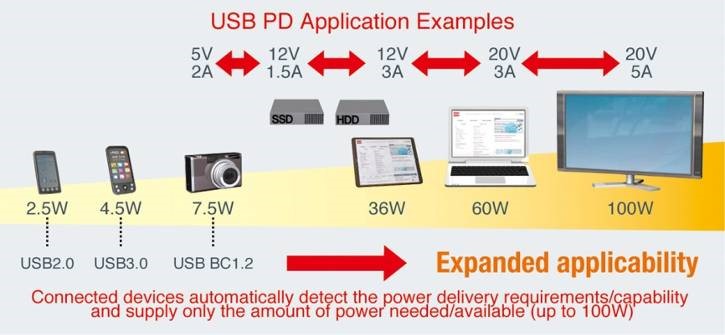
Willich-Münchheide/Nuremberg, November 24th 2015 – ROHM has recently announced the development of a new class of power receiver controller ICs compatible with the latest USB Power Delivery (Rev2.0) and Type-C (Rev1.1) standards and displays it at SPS IPC Drives (Hall 1, Booth 320). The BM92TxxMWV series supports not only conventional USB power supply up to 7.5W, but the newly expanded power range as well up to 100W (20V/5A) for USB Type-C connected devices. This will make it possible to drive equipment with larger power requirements such as TVs and PCs via USB and at the same time enable conventional USB-equipped portable devices (i.e. smart phones, tablets) to be charged up to 4 times faster than the previous standard.
Recent years have seen a greater demand to reduce e-waste in many regions, including Europe, for example by utilizing or developing common connectors and chargers for a variety of electronic devices. As such, the latest USB connector and power transmission standards developed by USB-IF (USB Implementers Forum), which includes USB Type-C, USB Power Delivery (along with USB Superspeed), and the new DisplayPort Alternate Mode standard for carrying video, are garnering increased attention as a true all-in-one cable solution by making it possible to deliver high power, high-speed data, and even 4K video simultaneously over a single USB cable/port. This will eliminate the need for dedicated cables, providing greater convenience while reducing clutter and waste.
Combining the new Type-C connector, which boasts a smaller, reversible, flippable cable design robust enough for laptops but slim enough for mobile phones, with USB PD that offers scalable power using multiple power delivery modes, results in a common, future-proof interface. ROHM leverages leading BiCDMOS processes and circuit technologies to develop USB PD controller ICs optimized for these latest USB standards.
Features
With the new Power Deliver standard, optimum power delivery is enabled in both directions between USB Type-C connected systems through a power contract that determines the Provider (Supply) and Consumer (Receiver) devices. This achieves maximum efficiency, since the Consumer only requests the required amount of power and the Provider only supplies the power available. Additional advantages include multiple scalable power delivery modes, from 7.5W (5V@1.5A) up to 100W (20V@5A), making it possible to drive larger electronic equipment such as TVs and laptops while enabling existing USB-equipped battery-driven devices to be charged over 4x faster than the previous standard.
Support for DisplayPort Alternate Mode is also provided for carrying video signals over USB, eliminating the need for dedicated video cables. The capability to deliver high-speed data, video, and an unprecedented amount of power over a single cable represents a breakthrough achievement that is expected to improve convenience while significantly reduce clutter and waste.
Advanced micro 0.13um BiCDMOS processes and circuit technology are utilized to achieve greater compactness and optimization. This will make it possible to eliminate the FET and separate power supply for power receiving operation. Compared to standard systems, the number of external parts can be reduced by more than 20 (including the external power supply IC), contributing to greater miniaturization.
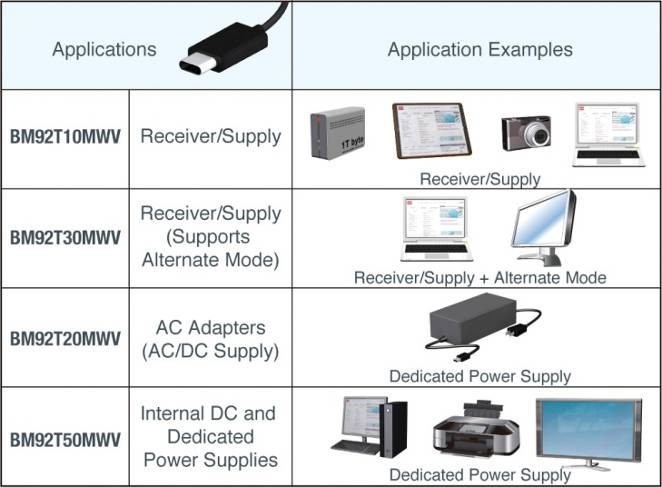
Product Lineup
Availability
Samples are available, OEM quantities in Dec. 2015.
Terminology
What is USB Power Delivery?
It is a USB power expansion standard for delivering up to 100W of power over USB. This allows for larger devices such as laptops to be powered that are not possible using conventional USB and speeds up charging time considerably for portables.
Under the USB PD protocol connected devices negotiate power requirements and enter into a contract to determine the optimum voltage and current levels. USB PD communication requires a new dedicated CC line that functions independently of conventional USB data transmission.
USB Type-C Standard (Type-C Connector)
Defined under USB3.1, USB Type-C is a new receptacle (concave connector), plug (convex connector), and cable standard featuring a more compact, reversible, flippable design. Unlike the previous standard that required Type B connectors to be connected to downstream devices and Type A connectors at upstream devices, both ends of a Type-C cable are the same and power requirements are negotiated between connected devices to determine the upstream and downstream facing ports (UFP and DFP), providing greater convenience and utility.
USB Implementers Forum, Inc. (USB-IF)
A standards promotion organization established in 1995 to support the creation, management, and adoption of USB standards; currently USB-IF has over 800 member companies and continues to help bring USB-compliant devices to market.
Cognex Corporation (NASDAQ: CGNX), the global technology leader in industrial machine vision, today announced that…
The Republic and Canton of Jura has signed a memorandum of understanding with SEALSQ and…
Delivers 3x density improvement in an ultra-compact form factor, supporting up to 3,456 fibers in…
Powered by agentic AI, Chamelio’s platform is primed to replace outdated legacy contract lifecycle management…
Universal Vapor Jet Corporation will introduce NovaJet, its first commercial thin-film deposition system based on…
Lessengers has unveiled a 3.2 Tbit/s near-packaged-optics platform that uses a glass packaging core, through-glass…